
In summary:
- Stop being a tour guide; become a “mission director” by creating challenges.
- Leverage their smartphones for creative tasks, not just passive scrolling.
- Limit visits to a “surgical strike” of 90 minutes to combat museum fatigue.
- Build excitement beforehand with movies and videos that create an emotional connection.
You know the scene. You’re standing before a magnificent historical monument, a place that has witnessed centuries of human drama, and you turn to share the moment with your teenager. They’re there, but not really. Hidden behind headphones, eyes glazed over, scrolling through a world a million miles away. That feeling of disappointment—the gap between the meaningful experience you wanted to share and the reality of their boredom—is a frustration every traveling parent knows well. You’ve probably tried the standard advice: “make it relevant,” “tell them interesting facts,” or “just take their phone away.”
But these approaches often fail because they miss a fundamental truth about Gen Z. They aren’t wired for passive consumption; they’re a generation of creators, critics, and curators. So, what if the problem isn’t the history, or even your teen? What if the problem is the role we’ve assigned them: a silent, bored audience member. The secret to unlocking their interest isn’t to force-feed them more facts, but to change their role entirely. It’s time to stop being a lecturer and start being an Experience Architect.
This guide is built on a single, powerful shift in perspective: transforming your teen from a passive tourist into an active participant with a mission. We’ll explore why traditional methods like audio guides are failing, how to build excitement before you even leave home, and how to design on-site experiences that feel more like a game than a lesson. By the end, you’ll have a playbook of creative, parent-friendly strategies to turn your next family trip into an adventure they’ll actually remember—and maybe even enjoy.
This article provides a complete framework for transforming your family’s historical travels. Below, you’ll find a summary of the key strategies we’ll explore, from understanding your teen’s mindset to executing the perfect visit.
Summary: A New Playbook for Engaging Teens in History
- Why Audio Guides Bore 90% of Gen Z Travelers?
- How to Turn a Museum Visit into a Competitive Scavenger Hunt?
- Private Guide or YouTube History: Which Keeps Attention Longer?
- The Mistake of Spending More Than 90 Minutes in a Gallery
- How to Use Movies to Build Hype Before Visiting a Historical Site?
- How to Choose a Hobby That Actually Makes You Smarter?
- How to Plan a Multi-City Trip for a Group of 6 Without Fighting?
- How to Read 52 Non-Fiction Books a Year While Working Full-Time?
Why Audio Guides Bore 90% of Gen Z Travelers?
The classic museum audio guide represents everything a modern teenager is conditioned to reject. It’s a passive, linear, one-way information dump in an era defined by interactive, user-controlled content. For a generation accustomed to skipping, swiping, and personalizing their media feeds, being tethered to a pre-recorded lecture is the digital equivalent of being stuck in traffic. The content is delivered at a fixed pace, with a formal tone, and offers no room for interaction or personal discovery. It’s a format that fundamentally misunderstands the attention economy they live in.
The data confirms this disconnect. In a world where streaming is king, the audio guide is a relic. Research shows that Gen Z spent almost two-thirds of their audio listening time with streaming music or music videos in 2024. They are not just consumers; they are curators of their own auditory experience. The audio guide strips away this agency, turning an opportunity for discovery into a chore. They want to be in the driver’s seat, not a passenger on a monotonous, pre-scripted tour.
Forward-thinking institutions are already catching on, realizing that engagement means speaking their language—both literally and technologically. They are shifting from monologue to dialogue.
Case Study: Museums Speaking Gen Z’s Language
Institutions like the Vancouver Maritime Museum and National Gallery of Singapore have successfully engaged younger audiences by ditching formal tones in favor of Gen Z humor and slang on their social media. Their viral videos proved that interactive, user-generated content styles resonate far more effectively than passive formats. This demonstrates a key principle: engagement skyrockets when teens feel the content is created for them, not just handed down to them.
The takeaway for parents is clear: handing your teen an audio guide and hoping for the best is a strategy destined for failure. To win their attention, you must offer an experience that mirrors the digital world they inhabit—one that is interactive, empowering, and gives them a sense of control.
How to Turn a Museum Visit into a Competitive Scavenger Hunt?
If audio guides are the problem, mission-based learning is the solution. The most effective way to transform a teen’s role from passive observer to active participant is to give them a job to do. A well-designed scavenger hunt isn’t about just finding objects; it’s about reframing the entire museum experience as a game with objectives, roles, and rewards. You are no longer dragging them through a gallery; you are unleashing them on a mission.
The key is to move beyond a simple “find this painting” checklist. A great museum mission is built on creativity and aligns with their native smartphone behaviors. Instead of banning phones, you integrate them as essential tools for the mission. Think photo challenges, creating TikTok-style reviews of an artifact, or capturing the most “meme-able” statue. The goal is to harness their content creator mindset for historical discovery.
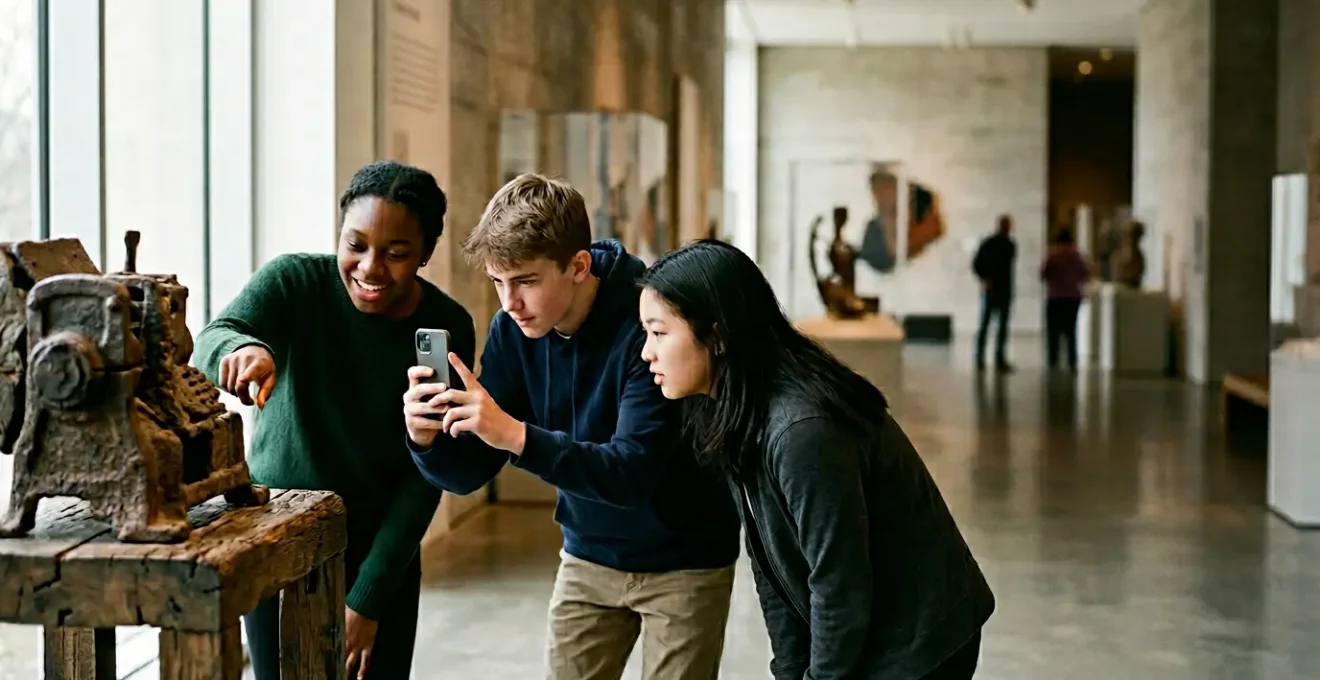
As the image above suggests, the right challenge can create authentic excitement and teamwork. By assigning roles, you add another layer of engagement and friendly competition. This structure gives their visit a purpose beyond just “looking at old stuff.” It becomes a collaborative or competitive game where history is the playground, not the lesson.
Here are some concrete ideas for building your mission:
- Mission-Based Objectives: Forget simple object lists. Design missions like “Find the best artifact to survive a zombie apocalypse and defend your choice,” or “Curate a 3-piece ‘exhibit’ on the theme of betrayal.”
- Smartphone-Native Tasks: Structure the hunt around photo challenges (e.g., “Find a portrait that looks like someone you know,” “Take a dramatic photo of a statue’s shadow”) or video reviews.
- Role-Playing Elements: Assign secret roles. ‘The Spy’ has to find hidden details in paintings. ‘The Critic’ must give star ratings to three exhibits. ‘The Storyteller’ has to invent a short story connecting two unrelated artifacts. ‘The Meme Lord’ captions museum art with modern humor.
- Digital Tools: For larger groups or more competitive families, apps like Goosechase can automate the process, create leaderboards, and save all the photo and video evidence of the fun.
By gamifying the experience, you’re not dumbing down history; you’re using the psychology of play to make it irresistible. You’re giving them agency, a voice, and a reason to look closer.
Private Guide or YouTube History: Which Keeps Attention Longer?
Once you’ve decided to move beyond the failed audio guide, a new question arises: how do you best deliver the stories behind the artifacts? The two main contenders are the traditional, high-cost private guide and the free, accessible world of YouTube history channels. Both have their merits, but understanding their trade-offs is key to crafting the perfect strategy for your family. A private guide offers unparalleled personalization, but a pre-visit YouTube binge can build a foundation of knowledge for a fraction of the cost—or for free.
A great private guide can be a game-changer. They can read the room, adapt to your teen’s fleeting interests, answer questions in real-time, and bring stories to life with a storyteller’s flair. However, a bad guide—one who is just a walking audio guide—can be an expensive disaster. YouTube, on the other hand, offers high-production value, snappy editing, and a tone that’s often more aligned with what Gen Z finds engaging. But it’s a passive experience that can’t answer a specific question about the artifact right in front of you.
This is where a hybrid strategy often wins. Use YouTube for pre-loading context. Watch a 15-minute video about the fall of the Roman Forum the night before your visit. This arms your teen with a baseline of knowledge and emotional connection. Then, on-site, you can either hire a guide for a shorter, more focused “power hour” to answer their now-educated questions, or simply guide the discovery yourself. As noted by experts, media is a powerful educator. As Paul B. Weinstein states in The History Teacher Journal:
We should acknowledge film and television as the great history educators of our time.
– Paul B. Weinstein, The History Teacher Journal
This table breaks down the factors to consider when choosing your approach. Notice how the Hybrid Strategy often provides the best of both worlds, mitigating the high cost of a guide and the passive nature of video.
| Factor | Private Guide | YouTube Pre-Learning | Hybrid Strategy |
|---|---|---|---|
| Engagement Type | Interactive dialogue | Passive consumption | Active preparation + Q&A |
| Personalization | High – adapts to questions | Low – fixed content | High – targeted discussions |
| Cost | High ($150-300/hour) | Free | Moderate (shorter guide time) |
| Attention Span | 60-90 minutes with breaks | 10-15 minutes per video | 30 min video + 45 min guided |
| Depth of Learning | Deep with skilled guide | Surface level overview | Baseline knowledge + expert insight |
| Teen Preference | Varies by personality | High familiarity comfort | Balanced approach |
The ultimate choice depends on your budget and your teen’s personality. But don’t underestimate the power of a well-chosen YouTube video to lay the groundwork for a much more engaging and cost-effective historical site visit.
The Mistake of Spending More Than 90 Minutes in a Gallery
One of the biggest mistakes well-intentioned parents make is planning marathon museum visits. The “we have to see everything” mindset is the fastest way to induce “museum fatigue”—that all-too-familiar feeling of mental and physical exhaustion that turns curiosity into a desperate search for the nearest exit. For teenagers, with their notoriously shorter attention spans, this fatigue sets in fast and hard. You might have a 4-hour ticket, but you likely only have about 90 minutes of quality attention. Pushing beyond that is counterproductive.
Scientific research backs this up. The term “museum fatigue” isn’t just an excuse; it’s a documented phenomenon. While you might think you have hours, studies on visitor behavior are sobering. Early research by Beverly Serrell on museum fatigue found that visitors often show signs of decreased engagement in as little as 20 minutes. The 90-minute rule is a generous upper limit designed to get you out while the experience is still positive.
The solution is to adopt a “surgical strike” mentality. Instead of a wandering, multi-hour slog, your visit should have a clear, defined, and short-term objective. The goal is not to see everything, but to have one or two powerful, memorable experiences. This “less is more” approach respects the limits of your teen’s attention span and ensures you end on a high note, leaving them wanting more (or at least not hating the experience). It transforms the visit from an endurance test into an exciting, focused mission.
Your Action Plan to Beat Museum Fatigue
- Define a ‘Surgical Strike’ Mission: Before entering, state a clear, limited objective. Example: “We are only seeing the Egyptian mummies and the Rosetta Stone, then we’re leaving for gelato. That’s the whole mission.”
- Use the ‘Split-Visit’ Strategy: For huge museums like the Louvre or the Met, plan two separate 75-minute visits on different days instead of one 3-hour marathon. Each visit should have its own theme.
- Schedule Mandatory ‘Reset’ Breaks: Set a timer. Every 45 minutes, stop. Find a bench, go to the cafe, or step outside. Do not discuss the exhibits. Let their brains reset.
- Go Against the Flow: Don’t follow the museum’s suggested path. Start with the most important exhibit on your list, when energy and focus are at their peak.
- Prioritize Quality Over Quantity: Explicitly state that the goal is to create one great memory, not to check every box. This relieves the pressure and focuses on the experience itself.
By embracing a shorter, more focused approach, you respect their cognitive limits and reframe the museum as a place of exciting discoveries, not endless hallways.
How to Use Movies to Build Hype Before Visiting a Historical Site?
The battle for your teen’s engagement begins long before you arrive at the gates of a historical site. The most powerful tool in your arsenal is pre-engagement, and nothing builds an emotional connection to a place faster than a great movie. A well-chosen film can transform a pile of old stones into the backdrop for an epic story they already care about. It provides context, characters, and emotional stakes that a guidebook or a plaque simply cannot match.
Watching *Gladiator* before visiting the Colosseum in Rome doesn’t just provide historical context; it populates the ancient arena with heroes and villains, drama and sacrifice. Suddenly, they’re not just looking at ruins; they’re standing where Maximus fought for his life. This is the power of narrative. It creates a scaffold of emotional investment upon which you can later hang historical facts. In fact, research confirms the power of this approach, with studies showing that over forty percent of people cite movies and TV as a primary way they connect with the past.
This strategy of leveraging popular media is so effective it has spawned its own industry: film tourism. Fans flock to locations to feel a tangible connection to the stories they love, and this provides a powerful lesson for parents.
Case Study: The Power of Film Tourism
The transformation of New Zealand’s tourism industry by *The Lord of the Rings* is a prime example. The films created such a powerful connection to the landscape that the Hobbiton Movie Set became a major international attraction. Similarly, Game of Thrones drove massive tourism to filming locations in Croatia and Ireland. These examples prove that visual media is an unparalleled tool for generating pre-visit excitement and creating a deep, lasting connection to a place that traditional methods can’t replicate.
Your job as an Experience Architect is to curate a “pre-visit syllabus.” A week before you visit the beaches of Normandy, watch *Saving Private Ryan*. Before a trip to Philadelphia, watch the musical *Hamilton*. You’re not just planning a movie night; you’re building the emotional foundation for an unforgettable historical encounter.
How to Choose a Hobby That Actually Makes You Smarter?
At first glance, this question might seem out of place. But reframing historical site visits through this lens is the key to unlocking a deeper level of engagement. When you transform a museum visit into a “mission” or a “scavenger hunt,” you’re not just making it more fun—you’re turning it into a hobby that actively builds cognitive skills. A hobby makes you “smarter” when it forces you to move beyond passive consumption and engage in active problem-solving, critical thinking, and creative synthesis. This is precisely what our new approach to historical travel does.
Think about the roles in our scavenger hunt: ‘The Critic’, ‘The Spy’, ‘The Storyteller’. These aren’t just playful names; they are micro-hobbies in critical thinking. ‘The Critic’ must develop and apply a rubric for what makes an exhibit “good.” ‘The Spy’ must engage in intense visual analysis, looking for details others miss. ‘The Storyteller’ must practice narrative construction and creative thinking, linking disparate elements into a coherent whole. This is active intellectual engagement, disguised as a game.
Choosing a hobby that makes you smarter is about selecting activities that require you to:
- Analyze Information: Breaking down complex subjects (like an artifact’s history) into understandable parts.
- Synthesize Information: Combining different pieces of information to form a new understanding (e.g., connecting two artifacts with a story).
- Evaluate and Critique: Making judgments based on a set of criteria (e.g., deciding which emperor had the “best” propaganda).
- Create Something New: Producing an output, whether it’s a photo, a story, a meme, or a well-defended opinion.
Instead of seeing history as a static subject to be learned, we are positioning it as a dynamic field for a new hobby: the hobby of being a historical detective, a cultural critic, or a visual storyteller. This approach doesn’t just make the visit more engaging in the moment; it builds the exact type of flexible, critical thinking skills that are invaluable in the 21st century. You’re not just showing them history; you’re teaching them how to think like a historian, an artist, and a strategist.
How to Plan a Multi-City Trip for a Group of 6 Without Fighting?
A family of four traveling together—each with their own interests, energy levels, and pet peeves—is functionally a “group of 6.” The two extra members are the ghosts of “I’m bored” and “Are we done yet?” The principles of successful group travel planning are therefore directly applicable to creating a harmonious and engaging family trip. The core challenge is the same: balancing diverse needs and expectations to prevent conflicts and meltdowns. The secret lies in proactive management, not reactive problem-solving.
Great group trip organizers, and great parents acting as Experience Architects, know that success depends on a few key strategies applied before the trip even begins. The “no fighting” part is a result of smart planning that gives everyone a sense of agency and ownership. It’s about creating a structure that accommodates individuality within a shared experience. When visiting a historical site, this means acknowledging that you’re managing a small group with very different goals.
Here are the core principles of group travel that apply directly to your family museum visit:
- Establish a Shared Goal (with Individual Paths): The overall mission is clear (“We are visiting the Acropolis”), but the individual missions can differ. Dad might be on a mission to photograph architectural details, while a teen’s mission is to find the best spot for a dramatic selfie. Both are valid and contribute to the shared experience.
- Assign Roles and Responsibilities: Just as one person in a group trip might be the “navigator” and another the “food researcher,” our scavenger hunt roles (‘The Spy’, ‘The Critic’) give each family member a specific job. This creates a sense of purpose and reduces friction.
- Agree on Non-Negotiables and Free Time: In group travel, you agree on one key activity per day, with the rest of the time being flexible. Applied to a museum: agree on the three “must-see” artifacts (the non-negotiables), and then allow for “free exploration” time where everyone can pursue their own interests for 15 minutes before meeting back up.
- Manage Expectations Proactively: The biggest source of conflict is a mismatch between expectation and reality. Clearly communicating the “Surgical Strike” plan (“We are here for 90 minutes, and here is what we are going to accomplish”) prevents the dreaded “endless walking” feeling and the arguments that come with it.
By treating your family like a small, diverse group and applying these principles, you shift from being a dictator of the itinerary to a facilitator of experiences. This collaborative approach is the foundation of a trip that is memorable for all the right reasons.
Key takeaways
- Shift your role from ‘lecturer’ to ‘mission director’ to make history an active game, not a passive lesson.
- The ’90-Minute Rule’ is your best friend. A short, high-impact visit beats a long, exhausting marathon every time.
- Build emotional context and excitement before your trip using movies and videos to transform abstract history into a compelling story.
How to Read 52 Non-Fiction Books a Year While Working Full-Time?
This final question seems the most disconnected, but it holds the ultimate secret to transforming your family’s relationship with learning and travel. The ability to read 52 books a year isn’t about magic; it’s about having a system. It involves techniques like scheduling reading time, choosing books strategically, knowing when to skim and when to deep-dive, and using tools to retain information. This same systematic approach is what separates a single fun museum visit from a lifelong habit of curious exploration.
The strategies we’ve discussed—pre-loading context with movies, using “surgical strikes,” and designing missions—are not just one-off tricks. They are components of a repeatable system for making learning efficient, engaging, and effective. Just as a prolific reader has a system for consuming knowledge from books, you, as an Experience Architect, can build a system for your family to absorb knowledge and create meaning from the world around them.
Think of it as developing a family “learning OS” (Operating System):
- The “Pre-Read” Phase: Just as a speed-reader might scan a book’s table of contents, your family’s pre-read is watching the relevant YouTube video or movie. You’re getting the big picture before diving into the details.
- The “Scheduled Time Block”: A serious reader schedules time to read. Your “90-minute surgical strike” is the same principle applied to a museum. It’s a dedicated, focused block of time protected from distractions and fatigue.
- The “Active Recall” Method: Great readers don’t just highlight; they write summaries to retain information. Your scavenger hunt, where teens have to create something (a photo, a story, a critique), is a form of active recall. It forces them to process and re-package the information, which is the most powerful way to learn.
By viewing your travel planning through this lens, you move beyond simply finding “fun activities.” You are consciously designing a system that teaches your children how to engage with new and complex information in a way that is sustainable and genuinely enjoyable. This is a skill far more valuable than knowing the dates of a particular battle. It’s the skill of learning itself.
Start today by reframing your next family outing not as a lesson, but as the first deployment of your new family learning system. Your role as a parent isn’t to be a walking encyclopedia, but to be the architect of an unforgettable adventure that quietly builds the smartest, most curious people you know.