
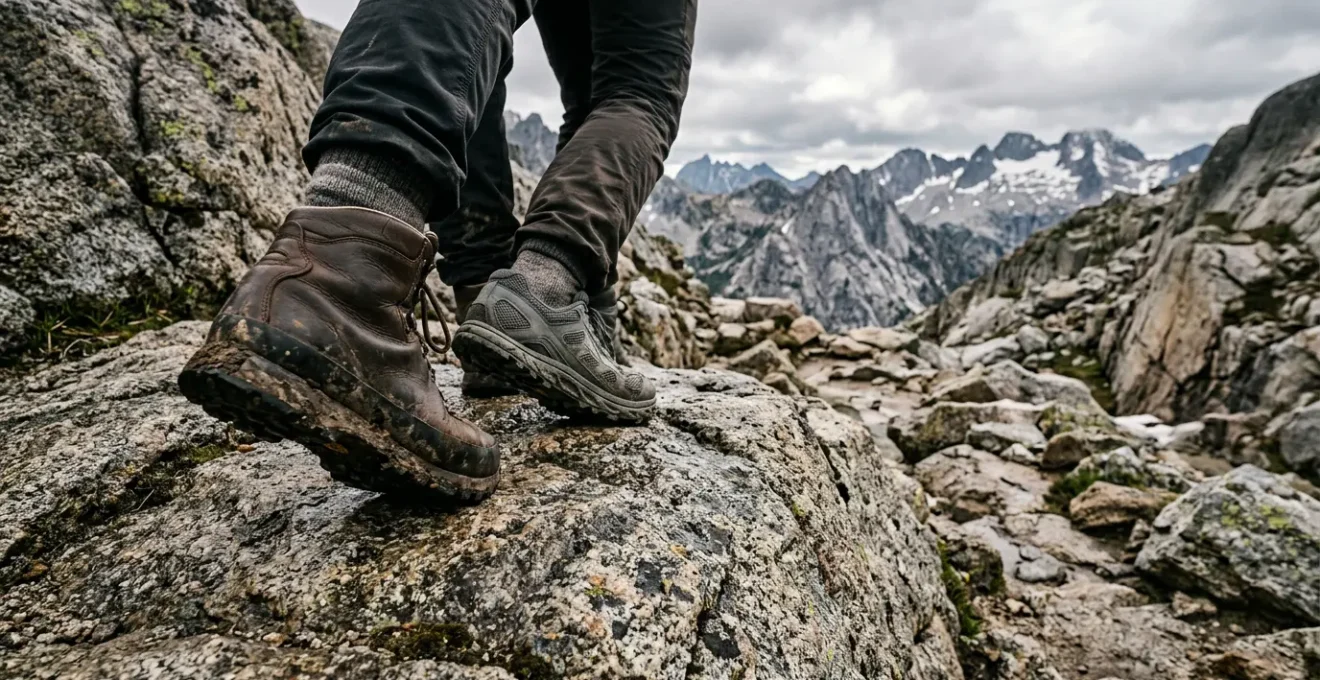
The long-held belief that high-top boots prevent ankle injuries is a dangerous oversimplification.
- True ankle stability comes from strengthening your foot’s biomechanics, not immobilizing it in a stiff boot.
- Moisture management and friction reduction (from socks and material choice) are more critical for preventing blisters than boot type.
Recommendation: Shift your focus from “support vs. weight” to understanding your foot, sock, and shoe as an integrated system designed for your specific trail conditions.
For any hiker, especially a beginner planning their first multi-day trek, the footwear debate is a rite of passage. The traditional wisdom, repeated around campfires and in gear shops, pits the heavy, sturdy hiking boot against the light, agile trail runner. One side champions the ankle-saving “support” of high-tops, while the other praises the fatigue-reducing “lightness” of a running shoe. This binary choice frames the problem as a simple trade-off between protection and performance.
But this debate misses the point entirely. It focuses on the equipment while ignoring the operator: your foot. What if the key to preventing injuries on rocky, uneven terrain wasn’t about choosing a side, but about understanding a deeper set of principles? The real answer lies not in a catalogue, but in biomechanics. It’s about how your foot is designed to work, and how your footwear choice either enhances or hinders its natural, injury-preventing functions.
This guide moves beyond the platitudes. We will dismantle the myths surrounding ankle support, blister prevention, and waterproofing. By focusing on the scientific principles of proprioception, friction management, and moisture transfer, you will gain a technical framework for selecting the right footwear. The goal isn’t to tell you what to buy, but to teach you how to think, so you can build a foot-sock-shoe system that keeps you safe and comfortable, mile after mile.
This article provides a technical deep-dive into the critical components of hiking footwear. The following sections will guide you through the evidence-based principles needed to make an informed decision.
Summary: Hiking Boots vs. Trail Runners: The Biomechanical Approach to Injury Prevention
- Why High-Top Boots Don’t Actually Prevent Ankle Sprains?
- How to Break in Leather Boots Without Getting Blisters?
- Gore-Tex or Mesh: Which Material Is Better for Summer Hiking?
- The Cotton Sock Mistake That Guarantees Blisters in 5 Miles
- How to Lace Your Shoes to Relieve Toe Pressure on Descents?
- Standing Desk or Treadmill Desk: Which Actually Burns More Calories?
- How to Protect Your Skin from Salt and Sun Damage During a 2-Week Beach Trip?
- Standing Desk or Treadmill Desk: Which Actually Burns More Calories?
Why High-Top Boots Don’t Actually Prevent Ankle Sprains?
The core argument for hiking boots is that a high, stiff collar prevents the ankle from rolling. This intuitive idea, however, is not strongly supported by biomechanical evidence. Ankle stability is not a passive process of being held in place; it’s an active, neurological function. The critical concept here is proprioception: your body’s ability to sense its position in space and react. When your foot starts to roll, nerves send a signal to your brain, which instructs the peroneal muscles along the outside of your lower leg to fire and pull the ankle back into alignment.
Stiff, high-top boots can interfere with this system. By restricting movement, they can dull the sensory feedback from the ankle, and as one analysis of research points out, this can lead to a delayed reaction of the peroneal muscles needed to prevent a sprain. Furthermore, research into athletic footwear has repeatedly questioned the benefit of high-tops. A prospective randomized study on basketball players, an activity with a high incidence of ankle sprains, found no significant difference in injury rates between those wearing high-top shoes and those in low-tops.
The feeling of “support” from a boot is real, but it’s largely a psychological comfort. It can also create a false sense of security, encouraging less careful foot placement. True protection comes from developing strong, reactive ankles through training and choosing footwear that allows your foot’s natural stabilization system to function optimally.
How to Break in Leather Boots Without Getting Blisters?
Unlike synthetic trail runners that are often comfortable out of the box, full-grain leather boots require a break-in period. This process is not about “softening” the boot, but about molding it to the unique contours of your feet while gradually conditioning your skin to potential friction spots. Rushing this is a direct path to debilitating blisters. The primary cause of blisters is a combination of friction, moisture, and pressure. A new, stiff leather boot provides all three in abundance.
The break-in strategy should be gradual. Start by wearing the boots around the house for a few hours at a time. Progress to short walks on paved surfaces, then to easier trails with a light pack. Experts recommend walking 15 to 20 miles in your new boots before committing to a long-distance trek. During this phase, pay close attention to “hot spots”—areas where you feel rubbing or pressure, typically the heel, toes, and top of the foot. It is crucial to address these immediately, not after a blister has formed.
Pre-emptive taping is the most effective professional strategy. Before you even start a hike, apply a durable athletic tape or a specialized product like Moleskin or Leukotape to your known hot spots. This creates a protective second skin that takes the friction, leaving your actual skin untouched.
As the illustration demonstrates, the goal is to create a smooth, secure barrier. This, combined with wearing the right wicking socks (never cotton) and ensuring a proper fit, is the technical solution to a pain-free break-in period. Remember, the boot is only one part of the system; your proactive care is the other.
Action Plan: Auditing Your Boot Break-in Process
- Identify Contact Points: With the boot on, identify and list all potential friction zones (heels, side of big/small toe, top of instep).
- Gather Your Tools: Inventory your blister-prevention kit. Do you have high-quality synthetic or wool socks, Moleskin or Leukotape, and scissors?
- Test for Coherence: During a short walk, does a hot spot form despite your taping? If so, your taping technique or sock choice may be inconsistent with the boot’s pressure points. Re-evaluate and adjust.
- Assess Friction vs. Fit: Is the hot spot from rubbing (friction) or from a poor fit (intense, localized pressure)? A friction issue can be taped; a fit issue may require lacing adjustments or professional boot stretching.
- Create an Integration Plan: Based on your audit, create a schedule. Week 1: Wear indoors. Week 2: Short walks on flat ground. Week 3: Hikes on moderate terrain with a pack. Do not proceed until each stage is free of hot spots.
Gore-Tex or Mesh: Which Material Is Better for Summer Hiking?
The choice between a waterproof Gore-Tex (or similar proprietary membrane) shoe and a non-waterproof, highly breathable mesh shoe is a critical decision, especially for summer hiking. The common assumption is that “waterproof” is always superior. However, the technology’s effectiveness is entirely dependent on environmental conditions. A waterproof-breathable membrane works by allowing small water vapor molecules (sweat) to pass through, while blocking larger liquid water molecules (rain).
This process is not magic; it relies on a physical principle called the moisture vapor pressure gradient. The membrane “breathes” effectively only when it is warmer and more humid inside your shoe than it is outside. This is often the case in cool, dry weather. However, on a hot, humid summer day, that pressure gradient can diminish or even reverse. When this happens, sweat vapor cannot escape efficiently, and your foot becomes soaked from the inside out. As one technical analysis notes:
Gore-Tex doesn’t breathe air; it transports moisture vapor. This process relies entirely on a pressure gradient, moving moisture from a high-pressure (warm, damp) zone to a low-pressure (cold, dry) one. When that gradient disappears, so does the breathability.
– Technical analysis by 3515 Footwear
In contrast, a non-waterproof mesh trail runner works on a different principle: rapid drainage and quick drying. While your foot will get wet during a creek crossing or a downpour, the open-weave material allows water to drain out almost immediately. The enhanced airflow then dries the shoe and sock as you hike.
For summer hiking in conditions where you expect rain or creek crossings, a mesh shoe is often the more practical choice. It embraces getting wet and prioritizes drying quickly, which is often a better strategy for preventing blisters and moisture-related skin issues than trapping sweat inside a “waterproof” shoe that can’t breathe.
The Cotton Sock Mistake That Guarantees Blisters in 5 Miles
The single most common and damaging mistake a beginner hiker can make is wearing cotton socks. The old adage “cotton kills” is no exaggeration when it comes to foot health on the trail. While soft and comfortable when dry, cotton has a fatal flaw: it is extremely hydrophilic, meaning it absorbs and holds onto water. A single cotton sock can absorb many times its weight in sweat.
Once wet, cotton loses all its beneficial properties. It mats down, loses its cushioning, and, most importantly, it holds moisture directly against your skin. This massively increases the frictional force between your foot, the sock, and the shoe. The wet, abrasive material constantly rubs against your softened, waterlogged skin, creating the perfect environment for painful blisters to form in a remarkably short time. The link between sock fiber and blisters is well-documented; a double-blind study of long-distance runners found that acrylic fiber socks were associated with far fewer and smaller blisters compared to cotton socks.
The technical solution is to use socks made from materials that are hydrophobic or hygroscopic.
- Synthetic fibers like acrylic, polyester, and nylon are hydrophobic. They do not absorb water; instead, they wick it away from the skin’s surface to the outside of the sock where it can evaporate.
- Merino wool is hygroscopic. Its unique fiber structure can absorb a significant amount of moisture vapor *before* it even condenses into liquid sweat, keeping the skin feeling drier for longer. It also retains its insulating properties when wet.
Choosing a high-quality, properly fitted sock made from Merino wool or a synthetic blend is a non-negotiable component of an effective injury-prevention system. It is just as important as the shoe you put over it.
How to Lace Your Shoes to Relieve Toe Pressure on Descents?
One of the most painful experiences on a multi-day trek is bruised or blackened toenails, a condition often caused by your foot sliding forward and your toes repeatedly slamming into the front of your boot on long descents. While proper fit is the primary solution, specific lacing techniques can provide a critical mechanical advantage, locking your heel into the back of the boot and creating space for your toes.
These techniques work by creating localized friction and pressure points in the lacing system, preventing the laces from slipping and loosening under the strain of downhill hiking. Instead of relying on a single, uniformly-tightened lace, you create independent zones of tension. Two of the most effective techniques are the Surgeon’s Knot and Window Lacing.
- The Surgeon’s Knot: This is used to lock off tension below a certain point. At the eyelets just before the top of your instep (where your foot begins to flex), instead of crossing the lace over once, wrap it over a second time. Pull it tight. This double-wrap creates a powerful knot that will not slip. You can then lace the upper portion of the boot with a different level of tension, keeping the instep locked down while allowing more flexibility at the ankle.
- Window Lacing (or Box Lacing): If you have a pressure point on the top of your instep, this technique can relieve it. When you get to the eyelets on either side of the pressure point, run the laces vertically up to the next eyelet on the same side, instead of crossing them over the foot. Then, resume your normal criss-cross pattern. This creates an open “window” in the lacing, completely removing pressure from that specific spot while keeping the rest of the foot secure.
Mastering these simple, no-cost adjustments transforms your laces from simple fasteners into a customizable suspension system for your foot. Before any long descent, take a moment to re-lace using a Surgeon’s Knot to secure your heel. It can be the difference between a comfortable walk out and a painful limp.
Standing Desk or Treadmill Desk: Which Actually Burns More Calories?
In an office, the debate between a standing desk and a treadmill desk is about static posture versus dynamic movement. This provides a perfect metaphor for the hiking footwear debate. A traditional, heavy leather boot is like a standing desk: it offers a rigid, stable, and seemingly secure platform. It locks your foot and ankle into a specific posture, prioritizing static support over all else. The energy cost of this system comes from its weight; carrying an extra pound on your feet is metabolically equivalent to carrying five pounds on your back.
A trail runner, conversely, is like a treadmill desk. It is built for dynamic function. Its flexibility allows the 33 joints and over 100 muscles, tendons, and ligaments in your foot to move, flex, and adapt to the terrain as they are designed to. This allows for a more natural and efficient gait. The energy savings from the lighter weight are significant over a long day, reducing overall fatigue. Lower fatigue means better focus and more precise foot placement, which is a primary driver of injury prevention.
So, which “burns more calories?” Carrying the heavy boot certainly requires more energy per step. But the goal of a hike is not to maximize caloric burn; it is to travel a distance safely and efficiently. The fatigue induced by a heavy boot can lead to late-day stumbles and injuries. The dynamic, lightweight system of a trail runner often proves to be the more efficient and sustainable choice for covering long miles on the trail, preserving energy for when it is needed most.
How to Protect Your Skin from Salt and Sun Damage During a 2-Week Beach Trip?
On a beach trip, salt and sun are the primary environmental threats to your skin. On a hiking trail, the equivalent threats to your feet are grit and moisture. Protecting your foot’s “skin” from this constant environmental assault is critical, regardless of your footwear choice. “Salt” on the trail is the fine, abrasive grit and sand that inevitably works its way into your shoes.
This grit acts like sandpaper, grinding away at your skin with every step and rapidly accelerating the formation of hot spots and blisters. The most effective technical defense against this is a pair of gaiters. These fabric shields cover the top of your boot and the lower part of your leg, creating a seal that prevents debris from entering your footwear. For low-cut trail runners, simple ankle gaiters are an essential, lightweight addition.
The “sun damage” equivalent on the trail is moisture management, both from sweat inside and rain/creeks outside. Just as sunburn damages skin, prolonged exposure to moisture (maceration) weakens it and makes it prone to tearing and blistering. A disciplined foot care routine is non-negotiable on a multi-day trip. At the end of each day, take off your shoes and socks, clean your feet thoroughly, and let them air dry completely. This daily “reset” allows your skin to recover and is one of the most effective injury prevention techniques available.
Key Takeaways
- Ankle stability is an active, biomechanical function (proprioception), not a passive benefit of high-top boots.
- Blister prevention relies more on moisture-wicking socks and pre-emptive taping of hot spots than on boot type.
- Waterproof (Gore-Tex) footwear is only effective in specific cool, dry conditions; breathable mesh is often superior for hot or wet summer hiking.
Standing Desk or Treadmill Desk: Which Actually Burns More Calories?
Revisiting the metaphor of the static desk versus the dynamic treadmill brings us to the core conclusion. Asking whether a hiking boot or a trail runner is “better” for preventing injuries is like asking whether a standing desk or a treadmill desk is “better” for office health. The answer depends entirely on the user’s goals, condition, and context. There is no single correct answer, only a series of trade-offs.
The choice is not about the object, but about the philosophy. Do you believe in immobilizing a joint to “protect” it, or in strengthening its natural function to allow it to protect itself? The evidence increasingly suggests that for most hikers on most trails, a system-based approach focused on dynamic function is superior. This involves strengthening your feet and ankles, choosing lightweight and flexible footwear that promotes natural foot movement, and mastering the associated skills of moisture and friction management.
This does not mean boots are obsolete. For heavy-load mountaineering, off-trail travel, or in snow, their rigidity and durability remain essential. But for the beginner hiker on a well-maintained trail, the “security” of a heavy boot often comes at the cost of proprioceptive feedback and increased fatigue, two factors that can actively contribute to injury.
The next logical step is to analyze your personal needs, your planned hikes, and your current physical condition to select the footwear system that will best serve you. Start by strengthening your feet and ankles, and then choose the tool that best complements that strength.