
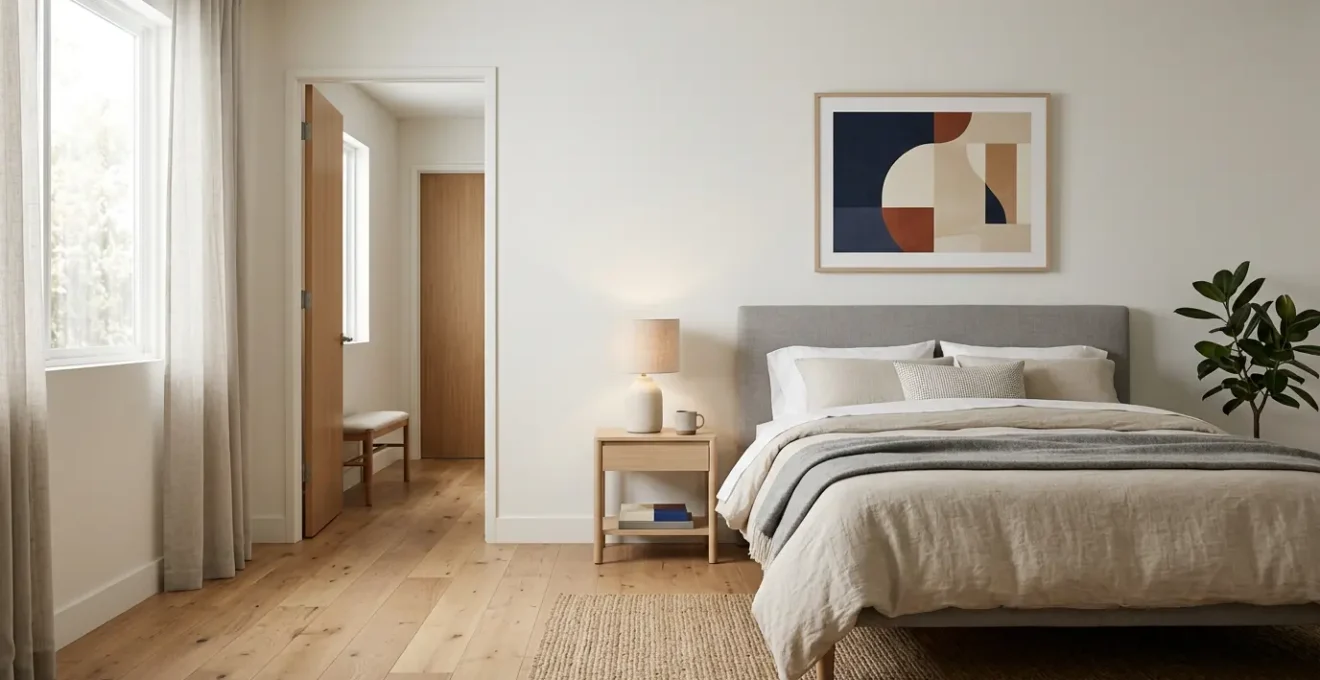
The persistent feeling of unease in your bedroom isn’t just in your head; it’s often a direct result of your bed’s placement violating your brain’s primal need for security.
- Positioning your bed so you can see the door without being in its direct path calms your subconscious threat-detection system.
- Sleeping against a solid wall acts as a psychological anchor, providing a sense of stability that a window cannot.
Recommendation: Arrange your bed diagonally opposite the door, against a solid wall, to create a “command position” that fosters deep, restorative rest.
That subtle, nagging feeling that something is “off” in your bedroom, the one that keeps you from sinking into truly deep sleep, isn’t just a matter of comfort. Many of us try to solve it with softer sheets, new pillows, or by simply trying to ignore it. We might even dabble in basic Feng Shui principles, hearing vague rules about “energy flow” without understanding their profound psychological roots. This feeling of unease often persists because its source isn’t material, but spatial and primal.
The truth is, your brain operates on an ancient, hard-wired survival program. It is constantly, subconsciously scanning your environment for potential threats. But what if the key to unlocking profound rest wasn’t about adding more comfort, but about strategically arranging your space to quiet this primal threat-detection system? This guide moves beyond superstition to explore the science of sanctuary engineering. We will deconstruct why certain bed placements trigger anxiety and how to leverage spatial psychology to transform your bedroom into a true haven of psychological security.
This article will guide you through the core principles of bed positioning, grounded in environmental psychology and our evolutionary needs. We will explore why seeing the door is non-negotiable, the critical difference between a wall and a window behind you, and how to eliminate the subtle environmental stressors that are sabotaging your sleep. Prepare to see your bedroom not just as a place to sleep, but as a habitat you can consciously design for deeper rest and peace of mind.
Summary: How to Arrange Your Bedroom for Primal Comfort and Security
- Why Sleeping with Your Back to the Door Triggers Anxiety?
- How to Arrange Your Bedroom So You Can See the Entrance?
- Headboard Against a Window or Wall: Which Offers Better Rest?
- The “Bookshelf Above Bed” Mistake That Disturbs Deep Sleep
- How to Seal Light Leaks Around Curtains for Total Blackout?
- How to Zone a 400 sq ft Studio to Create a Separate Bedroom Feel?
- How to Practice Mindfulness in a Toxic Office Environment?
- How to Practice Mindfulness in a Toxic Office Environment?
Why Sleeping with Your Back to the Door Triggers Anxiety?
The anxiety you feel when you can’t see your bedroom door isn’t irrational; it’s an echo of a deeply ingrained survival instinct. Your brain, particularly the amygdala, functions as a 24/7 threat-detection system. When you sleep with your back to the entrance, you are placing yourself in a position of maximum vulnerability from a primal perspective. You cannot see a potential threat entering, which forces your subconscious mind to remain in a state of low-level alert. This prevents you from achieving the deepest, most restorative stages of sleep.
This isn’t superstition, but a core concept in evolutionary psychology. Our ancestors’ survival depended on their ability to secure their resting place while being able to monitor their surroundings. This innate need for a secure and defensible position is part of our primal blueprint. Ignoring it creates a constant, low-grade stress that manifests as restlessness, difficulty falling asleep, or a general feeling of unease you can’t quite name. The goal is to signal safety to your primal brain, so it can finally stand down and allow for complete rest.
Case Study: The Evolutionary Roots of Bed Placement
This instinct is backed by research. For instance, a 2010 study in Evolutionary Psychology explored how people intuitively position their beds. The findings confirmed a clear preference for placing the bed where one can see the door without being immediately visible to someone entering. The study concluded that this tendency to maximize distance from the primary entrance is an evolutionary survival mechanism, directly comparable to how other species choose secure resting spots in the wild to avoid predators.
How to Arrange Your Bedroom So You Can See the Entrance?
The solution to the anxiety described is to adopt what Feng Shui calls the “command position.” This is the cornerstone of creating a psychologically secure bedroom. The principle is simple: position your bed so that you can see the door, but you are not directly in line with it. Typically, this means placing your bed diagonally opposite the door. This arrangement satisfies your brain’s need for spatial awareness and control, allowing your threat-detection system to relax.
Placing the bed here creates a clear line of sight to the room’s entrance, eliminating the element of surprise. You see who is entering long before they reach you, providing a crucial buffer. Being out of the direct path of the door—not having your feet point straight at it—also adds a layer of perceived safety, as you are not the first thing an intruder would encounter. This sense of control is fundamental to feeling secure, and a survey found that for 76% of respondents, feeling cozy and secure is a key factor in sleeping better. The command position is the ultimate expression of a cozy, secure layout.
As this overhead view illustrates, the optimal placement provides a commanding view without creating direct exposure. This balance between visibility and protection is the secret to calming your subconscious mind. It’s not about energy flow in a mystical sense, but about providing your primal brain with the visual data it needs to feel safe. This allows it to switch off from “guard duty” and let you descend into deep sleep.
Your Action Plan: Auditing Your Bedroom’s Command Position
- Points of Contact: Identify all entrances to your room (doors, large open archways). The main door is your primary point to monitor.
- Collecte (Inventory): Sketch your current bed position. Draw a line of sight from your pillow to the door. Is it clear, or is it blocked by furniture?
- Coherence (Alignment): Is your bed diagonally opposite the door? If not, what is the closest you can get to this position while maintaining a solid wall behind you?
- Mémorabilité/Émotion (Feel): Sit on your bed in the proposed new position. How does it feel? Do you feel more in control and aware of the space, or more exposed? Trust your gut feeling.
- Plan d’intégration (Action): Identify the one or two pieces of furniture you need to move to test the command position for a few nights. Prioritize the change that gives you the best view of the door.
Headboard Against a Window or Wall: Which Offers Better Rest?
Humans instinctively prefer sleeping with their backs protected while facing room entrances. This positioning satisfies our primal need to monitor our environment while feeling secure.
– Environmental Psychology Research, Yixiang Qiankun Feng Shui Analysis
While seeing the door is crucial, what’s behind you is equally important. Your head is your most vulnerable point during sleep. Placing your headboard against a solid, structural wall provides a powerful sense of support and stability. This solid backing acts as a psychological anchor, signaling to your subconscious that your “six” is covered. It creates a grounding effect, letting you know that nothing can approach you from behind, which is a fundamental requirement for deep relaxation.
In contrast, positioning your bed against a window creates a feeling of profound vulnerability, even if you live on a high floor. Windows represent a permeable boundary. They don’t offer the same structural or acoustic protection as a solid wall. Your subconscious mind is aware of the potential for noise, light changes, drafts, or even the theoretical possibility of breakage. This constant, low-level sensory input keeps your nervous system slightly on edge. A wall, on the other hand, is a symbol of permanence and protection, allowing your mind to fully let go of its environmental monitoring duties.
The ideal setup, therefore, combines the command position with a solid backing. Your bed should be against a solid wall, preferably the one furthest from and diagonal to the door. This combination offers the best of both worlds: a clear view of any approaching presence and the unshakeable security of a protected back. It’s the ultimate expression of a secure nest, engineered for peace of mind and the deepest possible rest.
The “Bookshelf Above Bed” Mistake That Disturbs Deep Sleep
The space above your head should be clear and open. Placing heavy objects like a bookshelf, a large piece of art, or even exposed beams directly over your bed creates what is known in environmental psychology as “psychological pressure.” While you may consciously know the shelf is secure, your primal brain interprets any heavy overhead object as a potential threat. This creates a subtle, persistent stress that can disrupt your sleep cycles, manifesting as headaches, restlessness, or difficulty reaching deep sleep.
This isn’t just a feeling; it has a physiological basis. The visual presence of clutter or potential hazards can elevate stress hormones. Research shows that a cluttered environment can lead to 20-30% higher cortisol levels. A bookshelf packed with items directly above your head is a form of concentrated visual clutter and perceived physical threat. This constant sensory input tells your nervous system that your environment is not completely safe, hindering its ability to fully disengage for the night.
Traditional Feng Shui wisdom echoes this, warning that “overhead beams create psychological pressure and energy obstruction.” While the language is different, the principle is the same. Whether you call it blocked “qi” or a subconscious threat response, the effect is a disruption of your peace. For the most restorative sleep, the area above your headboard should be empty. This gives your psyche the “breathing room” it needs, signaling that your most vulnerable space is entirely free from overhead threats, both real and perceived.
How to Seal Light Leaks Around Curtains for Total Blackout?
Beyond spatial arrangement, light is the most powerful external regulator of your sleep-wake cycle. Even small amounts of light leaking into your bedroom can suppress the production of melatonin, the hormone that tells your body it’s time to sleep. “Light leaks”—the slivers of light that creep in around the edges of curtains or under the door—are a major, often-overlooked saboteur of deep sleep. Achieving total darkness is not a luxury; it’s a biological necessity for optimal rest.
The goal is to create a “light-proof” sanctuary. This involves a layered approach, starting with the largest source of light—the windows—and then addressing the smaller, more insidious leaks. Standard curtains, even “blackout” ones, often fail because light spills from the top, sides, and bottom. Sealing these gaps is the final step in engineering your bedroom for psychological and physiological security. A truly dark room tells your brain that it is safe, nighttime, and time for deep, uninterrupted restoration. Follow this hierarchy to methodically eliminate every photon.
5-Step Hierarchy to Achieve Complete Bedroom Darkness
- Step 1: Install blackout curtains with triple-weave fabric that blocks 99% of light, ensuring they extend well beyond the window frame on all sides.
- Step 2: Add magnetic tape or Velcro strips along the vertical edges of the curtains and the wall to seal the gaps where light leaks through the sides.
- Step 3: Install a pelmet, cornice, or a simple curtain valance at the top of the window. This box-like structure is designed specifically to block light leakage from above the curtain rod.
- Step 4: Use a draft stopper or a dedicated door sweep under your bedroom door. This is often the second most significant source of light pollution in a room.
- Step 5: For the ultimate solution, apply blackout window film directly to the glass. This permanent layer provides an additional barrier for both light and privacy, working in tandem with your curtains.
How to Zone a 400 sq ft Studio to Create a Separate Bedroom Feel?
Living in a studio apartment presents a unique challenge to psychological security: when your entire life happens in one room, how do you signal to your brain that it’s time to rest? The key is not physical walls, but psychological separation. Sanctuary engineering in a small space means creating distinct “zones” that tell your mind what activity belongs where. By visually and functionally separating your sleeping area, you create a dedicated haven for rest, even without a door.
The most effective tool for this is the room divider. This doesn’t have to be a solid wall. A tall, open-back bookshelf (like an IKEA KALLAX) can create a sense of separation while still allowing light to pass through, preventing the space from feeling cramped. A stylish folding screen or even strategically hung curtains from the ceiling can also carve out a bedroom nook. The goal is to break the line of sight between your bed and your “active” zones, like your desk or kitchen. When you can’t see your workspace from your pillow, your brain is more likely to switch off from work-related stress.
Another powerful technique is to use area rugs. Placing a distinct rug under your bed and nightstands visually anchors the sleeping zone. It creates a “room within a room,” a clear boundary that your feet cross when you transition from the day’s activities to nighttime rest. Combine this with dedicated lighting—a soft, warm lamp in the sleep zone and brighter, cooler light in the work/living zone—to further reinforce the psychological divide. By creating these sensory cues, you are training your brain to associate that specific corner of your studio with nothing but peace and sleep.
Key Takeaways
- Bed placement is a dialogue with your primal brain’s need for safety.
- The “command position” (view of the door, solid wall behind) is the cornerstone of psychological security in the bedroom.
- Overhead objects and visual clutter act as subconscious stressors, elevating cortisol and disrupting sleep.
How to Practice Mindfulness in a Toxic Office Environment?
Just as we engineer our bedroom for psychological safety, we can apply similar principles of spatial awareness and intentionality to navigate stressful external environments like a toxic office. While you can’t always change the environment, you can change your relationship to it. Mindfulness is the practice of creating an inner sanctuary, a pocket of calm that you control, regardless of the chaos around you. It begins with consciously defining your personal space, no matter how small.
Your desk is your command position in the office. Keep it intentionally clear of clutter to reduce subconscious stress. Arrange your monitor and chair, if possible, so you have a broad view of the area and aren’t easily startled from behind. This mirrors the principle of seeing the door in your bedroom. Furthermore, use sensory anchors to ground yourself. A small plant, a personal photo, or even a specific texture on your mousepad can serve as a focal point. When stress rises, you can gently bring your attention to this object, using it as a tool to pull your mind away from the surrounding toxicity and back to your own controlled space.
Practice “micro-doses” of mindfulness throughout the day. This could be as simple as taking three conscious breaths before answering a difficult email. Or, you can use the walk to the coffee machine as a walking meditation, focusing on the feeling of your feet on the floor instead of replaying a negative interaction. These small acts create psychological distance, allowing you to observe the office drama without being consumed by it. You are building a buffer, an invisible shield of awareness that protects your inner peace.
How to Practice Mindfulness in a Toxic Office Environment?
Beyond managing your personal space, mindfulness in a toxic environment is about mastering your reactions. The previous section focused on creating an external anchor; this one focuses on strengthening your internal anchor. A toxic workplace often thrives on emotional reactivity. Mindfulness provides the crucial pause between a trigger (like a passive-aggressive comment) and your response, giving you the power to choose a calm, deliberate action instead of an impulsive, emotional reaction.
One powerful technique is creating a “psychological bubble.” Before entering a stressful meeting or interacting with a difficult colleague, take a moment to visualize a bubble of calm, clear energy around you. This isn’t a magical shield, but a mental model. It reminds you that the negativity of others is external to you and doesn’t have to penetrate your inner state. When a toxic comment is made, you can visualize it bouncing off the surface of this bubble, allowing you to observe it without absorbing it. This creates the mental space to respond with “Thank you for your perspective” instead of defensiveness.
Finally, practice mindful communication. When you have to engage, listen fully without planning your rebuttal. Focus on the speaker’s words, not the emotional charge behind them. When it is your turn to speak, do so with intention and precision, avoiding blame or emotional language. This approach de-escalates tension and models a different way of interacting. You are not just protecting yourself; you are subtly influencing the environment. By refusing to participate in the cycle of toxicity, you are reclaiming your power and maintaining your psychological security, one conversation at a time.
Begin tonight by making one small adjustment based on these principles. Creating your sanctuary is an iterative process, and the first step is reclaiming your sense of security where you rest.