
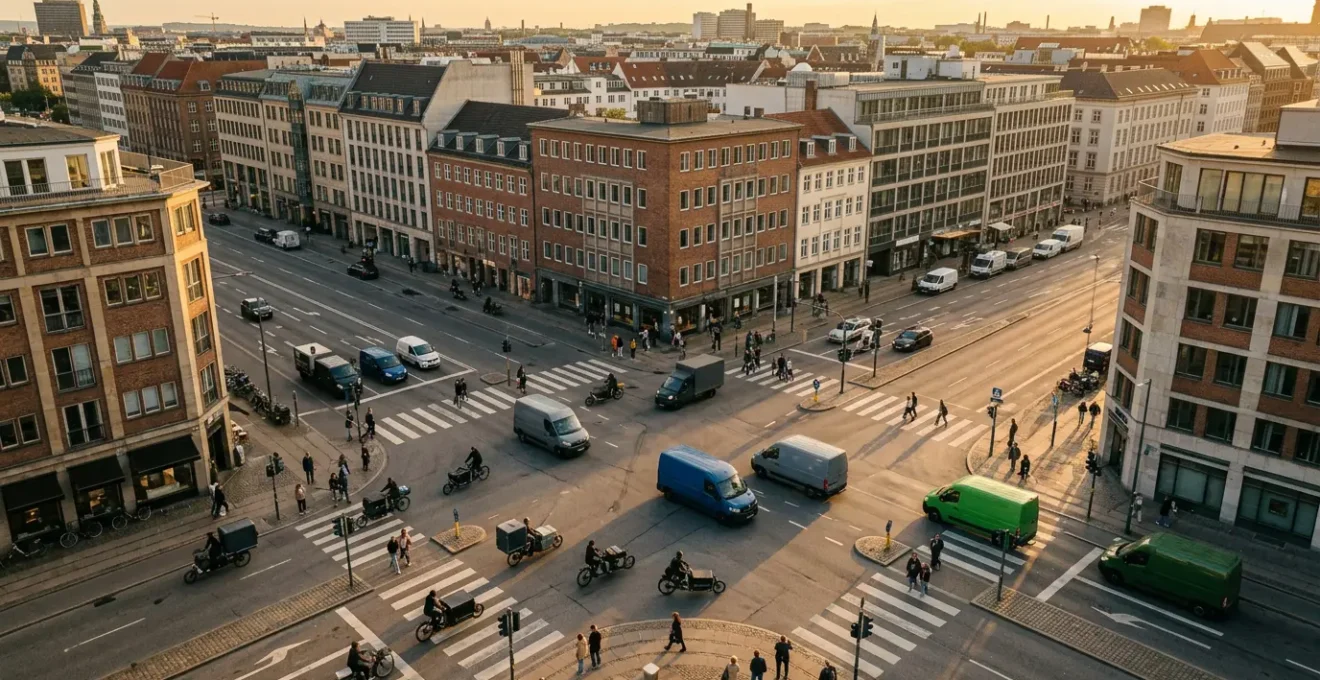
The solution to the last-mile crisis isn’t found in faster vehicles, but in fundamentally re-engineering the urban environment itself.
- Treating urban assets like parking spaces as logistics nodes (micro-hubs) is more effective than optimizing van routes alone.
- A symbiotic system of vans (mobile warehouses) and e-cargo bikes (agile delivery units) consistently outperforms traditional van-only models in congested areas.
Recommendation: Your first step should be to audit municipal zoning codes and advocate for regulatory sandboxes, not just to update your vehicle fleet.
The sight is familiar in any dense urban center: a delivery van, double-parked, engine running, causing a cascade of traffic delays. For logistics managers and urban planners, this isn’t just an inconvenience; it’s the daily, costly reality of the last-mile delivery problem. The conventional wisdom focuses on technological fixes—faster electric vans, smarter route optimization software, or even futuristic drones. While these have a role, they often attempt to optimize a fundamentally broken system, treating the city as a static obstacle course rather than a dynamic environment that can be reshaped.
What if the core issue isn’t the vehicle, but the infrastructure it operates within? The true, lasting solution lies not in simply making the van more efficient, but in rethinking the urban fabric itself. This requires a structural shift in perspective, moving from vehicle-centric logistics to an integrated, ecosystem-based approach. It involves seeing parking spaces not as dead ends, but as potential logistics assets; viewing zoning laws not as barriers, but as tools for innovation; and understanding that the answer to gridlock might be a bicycle, not a bigger truck. This guide explores the strategic and structural changes needed to solve the last-mile problem by transforming the city itself into a key part of the solution.
This article provides a comprehensive framework for logistics managers and urban planners to tackle last-mile delivery challenges. It breaks down the core issues, from the hidden costs of idling to the untapped potential of urban space, and offers structural, forward-looking solutions. Explore the sections below to build a resilient and efficient urban logistics ecosystem.
Summary: Rethinking Urban Logistics Beyond the Van
- Why Delivery Vans Spending 30% of Time Idling Is Bankrupting Logistics?
- How to Convert Parking Spaces into Micro-Distribution Hubs?
- E-Cargo Bikes or Electric Vans: Which Is Faster in Gridlock?
- The Zoning Oversight That Can Get Your Micro-Hub Shut Down
- How to Use AI Routing to Avoid School Zones During Pickup Hours?
- How to Insure Your Electric Scooter Against Theft and Injury?
- How to Survive the First Year of Street Pedestrianization as a Retailer?
- How to Insure Your Electric Scooter Against Theft and Injury?
Why Delivery Vans Spending 30% of Time Idling Is Bankrupting Logistics?
Engine idling is more than just a source of emissions and noise; it’s a silent financial hemorrhage for logistics companies. When a delivery van is idling, it is generating zero revenue while actively consuming fuel, incurring engine wear, and contributing to urban congestion. This unproductive time is a critical symptom of a dysfunctional last-mile system, where drivers are forced to circle for parking or wait for delivery windows. The financial impact is staggering. Industry data reveals that excessive idling costs fleet operators approximately $12,000 per truck annually in wasted fuel and maintenance. This figure doesn’t even account for the associated costs of parking fines, traffic delays, and the negative brand perception from contributing to neighborhood pollution.
The problem is systemic. A significant portion of this idling time—often 30% or more of a driver’s shift—is spent searching for a legitimate parking spot near the delivery point. In high-density zones, this search is often futile, leading to double-parking, which exacerbates traffic flow problems for everyone. This cycle of inefficiency highlights a fundamental disconnect: we are deploying high-capacity vehicles designed for highways into urban environments that demand agility and minimal dwell time. The idling engine is the sound of a logistics strategy clashing with urban reality.
As this image suggests, the static nature of an idling vehicle represents frozen capital and wasted potential. Every minute the tire isn’t turning for a productive reason is a minute the entire logistics chain is losing money. Addressing this requires moving beyond driver behavior modification and tackling the root cause: the lack of designated, efficient transfer points within the urban fabric. Simply put, we must reduce the need for the large van to stop and wait in the first place.
How to Convert Parking Spaces into Micro-Distribution Hubs?
The solution to the idling problem lies in a radical strategy of asset repurposing: viewing existing urban infrastructure, particularly parking spaces, as potential logistics nodes. Instead of one large van making 100 individual stops, imagine it making one stop to unload into a pre-established micro-distribution hub. From this hub, a fleet of smaller, more agile vehicles—like e-cargo bikes or pedestrian couriers—can perform the final, granular deliveries. This “hub-and-spoke” model, integrated directly into the urban fabric, fundamentally changes the delivery equation.
This isn’t a theoretical concept. In 2015, UPS partnered with the City of Hamburg to pilot such a program. Four loaded trucks with large 20m² containers were parked at strategic, pre-approved locations in the inner city each morning. These containers acted as pop-up micro-hubs, from which couriers on zero-emission cargo bikes completed the final delivery leg. The initiative successfully reduced the presence of large trucks in the city center and enabled a more environmentally friendly delivery model. However, it also highlighted a key challenge: the project operated under special-use permits with monthly fees, lacking the long-term planning security needed for widespread investment.
Implementing this strategy requires a systematic approach to site selection. A successful micro-hub network depends on several key factors:
- Proximity: Hubs must be located within 1-5 kilometers of the final delivery destinations to maximize the efficiency of last-mile vehicles like cargo bikes.
- Capacity and Infrastructure: The physical footprint can range from 1,000 to 10,000 square feet, incorporating essential infrastructure like charging stations for EVs and battery-swapping capabilities.
- Accessibility: They are most effective serving areas with restricted traffic or limited curb space where large vans struggle to operate.
- Density: The model thrives in high-density areas with a high volume of parcels, allowing for consolidated and efficient final-mile runs.
By transforming underutilized real estate—from parking lots to vacant storefronts—into a network of micro-hubs, cities and logistics companies can create a more resilient, efficient, and sustainable delivery ecosystem.
E-Cargo Bikes or Electric Vans: Which Is Faster in Gridlock?
In the congested arteries of a dense city, the answer is unequivocally the e-cargo bike. While an electric van is a cleaner version of its diesel counterpart, it is still a van—subject to the same traffic jams, parking scarcity, and road restrictions. The e-cargo bike, by contrast, operates on a different paradigm. It leverages bike lanes, shortcuts through pedestrianized zones, and can be parked directly at the destination’s doorstep, virtually eliminating the time-consuming “last 50 meters” problem that plagues van drivers.
The data supporting this is compelling. A comprehensive GPS-tracking study in Brussels found that electric cargo bikes delivered 10.1 packages per hour compared to just 4.9 for vans. The bikes were not only more than twice as productive but also achieved this with shorter routes and significantly faster average speeds in the urban core. This concept of modal symbiosis—where the large van acts as a mobile warehouse feeding agile e-bikes—is the key to unlocking efficiency. The van handles the high-capacity, long-haul “middle mile” to the edge of the congested zone, and the bike executes the surgical, high-speed final mile.
The operational and financial advantages become even clearer when comparing the two modes directly. The e-cargo bike isn’t just a greener option; it’s a superior business tool for high-density environments.
The following table, based on urban performance data, starkly illustrates the e-cargo bike’s superiority across key metrics in a congested city center.
| Performance Metric | Electric Cargo Bikes | Delivery Vans |
|---|---|---|
| Average Speed (Brussels) | 16 km/h | 11 km/h |
| Route Distance | 30% shorter routes | Standard road routes |
| Delivery Time (8.5 km route) | 48 minutes | 99 minutes |
| Packages per Hour | 10.1 deliveries | 4.9 deliveries |
| Parking Distance to Destination | 30 meters average | Up to 25 min searching per stop |
| Cost per Parcel | €0.10 | €1.05-€1.10 |
| GHG Emissions Reduction | 96-98% lower vs vans | Baseline |
The Zoning Oversight That Can Get Your Micro-Hub Shut Down
Even the most brilliant logistics strategy can be defeated by a single piece of paper: a zoning violation notice. The concept of converting retail or parking space into micro-distribution hubs runs headfirst into a critical regulatory gray area. Most municipal zoning codes are antiquated, strictly categorizing land use as “commercial,” “industrial,” or “residential.” A micro-hub, which functions as a mini-warehouse (industrial) but is located in a retail area (commercial), defies these neat definitions. This ambiguity is a significant risk for operators, as a facility can be shut down by local authorities interpreting it as an unpermitted industrial use in a commercial zone.
Forward-thinking planning experts are sounding the alarm, urging municipalities to proactively update their regulations to accommodate this new logistics reality. As planning experts from Clarion Associates state, “Communities will do well to consider whether and how their land-use policies address this changing landscape and amend their zoning regulations if needed.” Ignoring this step is a recipe for conflict and stranded investments.
Communities will do well to consider whether and how their land-use policies address this changing landscape and amend their zoning regulations if needed.
– Clarion Associates Planning Experts, Clarion Associates – Store or Warehouse? Zoning for Micro-Fulfillment Centers
New York City provides a pioneering model for how to navigate this challenge through data-driven governance. Recognizing the need for these facilities, the city amended its zoning resolution to create a special permit process for micro-distribution centers. In many commercial districts, facilities up to 5,000 square feet are permissible but require a review by the Board of Standards and Appeals. This review assesses community impact, ensuring the use won’t impair neighborhood character or create significant traffic congestion. Crucially, the framework also considers the concentration of facilities, looking at the number of existing hubs within a 500-foot radius. This creates a “regulatory sandbox”—a defined, flexible framework that allows for innovation while providing safeguards and predictability for both operators and the community. For logistics managers, partnering with city planners to advocate for such frameworks is as crucial as site selection itself.
How to Use AI Routing to Avoid School Zones During Pickup Hours?
Artificial Intelligence in logistics is about much more than just finding the shortest route. Its true power lies in its ability to perform dynamic, multi-factor optimization in real-time. A key application of this is creating “smart” routes that are not only efficient but also context-aware and socially responsible. For instance, an AI-powered system can be programmed with time-based geofencing rules to automatically reroute delivery vehicles away from school zones during the chaotic morning drop-off and afternoon pickup hours. This simple constraint reduces congestion, improves safety for children, and enhances the company’s reputation as a responsible community partner.
This level of sophistication is achieved by feeding the AI algorithms a rich diet of data. The system analyzes real-time traffic from GPS probes, predicts congestion based on historical trends, and factors in variables like weather conditions, road closures, and even city-wide events. A leading e-commerce company that implemented such a system reduced its average delivery times by 20% while cutting operational costs by 15%. This demonstrates that socially responsible routing and peak efficiency are not mutually exclusive goals; they are, in fact, complementary.
The most advanced models integrate AI with the vehicle technology itself. A real-world case study in Lisbon demonstrated that AI-driven optimization combined with electric vehicles achieved a 15-20% reduction in delivery time, a 10-25% gain in energy efficiency, and up to a 40% decrease in emissions. The AI doesn’t just plan the route; it manages the vehicle’s energy consumption, plans charging stops at optimal times, and adjusts to live conditions to ensure promises are met. This is data-driven governance at the fleet level, where every decision is optimized against a matrix of cost, speed, energy use, and community impact.
How to Insure Your Electric Scooter Against Theft and Injury?
The rise of micro-mobility fleets, including commercial-use electric scooters and cargo bikes, has created a significant challenge for the traditional insurance industry. Standard commercial auto policies are ill-suited for these new vehicle types, and personal policies often exclude commercial use. This leaves a dangerous gap in coverage for theft, vehicle damage, and—most critically—liability for injury to the rider or a third party. For a fleet operator, navigating this landscape requires a proactive, data-driven approach to build a new kind of insurance model from the ground up.
The key is to use technology to quantify risk and demonstrate safety. Insurers price risk based on historical data, which is scarce for commercial e-scooter fleets. By implementing telematics—GPS tracking, speed monitoring, and G-force sensors to detect hard braking or crashes—fleet managers can generate their own evidence-based risk profile. This data can be used to create a Fleet Safety Score, proving that your riders are operating safely, adhering to routes, and using vehicles within designated hours. When you can present an insurer with a dashboard showing a low-risk operational profile, you move from being an unknown quantity to a preferred client, enabling you to negotiate significantly lower premiums.
Building a robust insurance framework is a non-negotiable step for any serious micro-mobility operation. It protects your assets, your riders, and your business from catastrophic liability. The following checklist outlines the key steps to create a defensible and cost-effective insurance model for your fleet.
Your Action Plan for a Data-Driven Insurance Model
- Implement telematics systems: Install GPS tracking, speed monitoring, and hard braking event detection on all fleet vehicles to collect objective operational data.
- Create a Fleet Safety Score: Use collected data (time-of-day usage, acceleration events, route adherence) to build a comprehensive safety profile for your entire operation.
- Negotiate evidence-based premiums: Present insurers with your operational data and Fleet Safety Score to prove safe practices and secure lower rates.
- Distinguish liability models: Clearly define whether you need a gig-worker (third-party platform) or full-time employee (comprehensive corporate policy) insurance structure.
- Address vehicle-specific coverage: Work with your broker to define policies that explicitly cover non-standard vehicle types, including cargo bikes and various e-scooter models.
How to Survive the First Year of Street Pedestrianization as a Retailer?
For retailers, the announcement of a street pedestrianization plan often triggers panic. The primary fear is that cutting off car access will decimate customer traffic and create a logistical nightmare for receiving inventory. While these are valid concerns, viewing pedestrianization as a threat is a strategic mistake. Instead, innovative retailers should see it as an opportunity to transform their store into a more attractive destination and to participate in a more efficient, modern logistics network. The key to survival and growth is embracing a cooperative, micro-hub-centric model.
The experience of Bologna, Italy, offers a powerful blueprint. Faced with access issues in its historic, pedestrianized center, the city supported the DECARBOMILE project. This initiative established micro-hubs at the edge of car-free zones. Standard delivery trucks unload goods at these hubs, which are then transferred to low-emission cargo bikes for the final journey to the storefront. This not only maintained the supply chain but also allowed retailers to partner with logistics firms, transforming their stores into hyperlocal fulfillment points for online orders. The increased foot traffic from a more pleasant, car-free street, combined with a new role in the e-commerce ecosystem, turned a potential crisis into a competitive advantage.
Retailers on a newly pedestrianized street can’t wait for the city to solve their problems; they must act collectively. By forming coalitions, they can thrive by implementing a shared logistics model. This cooperative approach involves several key actions:
- Establish edge-of-zone transfer points: Work with the municipality to designate consolidation areas where standard delivery vehicles can efficiently transfer goods.
- Deploy a shared e-cargo bike fleet: Pool resources to lease or purchase a fleet of e-cargo bikes for all participating retailers, drastically lowering individual costs and providing on-demand access.
- Implement reverse logistics: Use the same micro-hub infrastructure for consolidated waste recycling and processing customer returns, adding another layer of efficiency.
- Create a curb-to-store relay service: Coordinate scheduled bulk deliveries to the zone’s edge, using a dedicated service with electric carts or bikes for the final relay to each storefront.
By shifting from an individual to a collective mindset, retailers can turn the challenge of pedestrianization into a catalyst for creating a more efficient, sustainable, and ultimately more profitable business environment.
Key Takeaways
- The massive financial cost of idling is a symptom of systemic dysfunction, not just poor driver habits.
- Urban space itself, particularly underutilized parking, is the most valuable and overlooked asset in modern logistics.
- The most profound solutions are found in policy and regulation—zoning reform is more impactful in the long run than a new routing algorithm.
How to Insure Your Electric Scooter Against Theft and Injury?
While the previous section focused on building a data-driven insurance model from the operator’s perspective, the broader strategic challenge lies in navigating the complex policy and liability landscape. For urban planners and senior logistics executives, the issue is not just insuring their own fleet but fostering a stable, insurable ecosystem for all micro-mobility players. A single, high-profile, uninsured accident can set back public and regulatory acceptance by years. Therefore, a structural approach to insurance is a prerequisite for long-term growth.
A primary consideration is the divergence in liability models. A company with full-time, W-2 employee riders can be covered under a comprehensive corporate policy, where the company assumes full liability. This is the most straightforward model. However, for platforms that rely on gig-economy (1099) workers, the lines are blurred. Is the platform, the rider, or a third-party insurer responsible in case of an accident? This ambiguity creates significant risk and often leads to prohibitively high insurance costs. Creating clear, city-approved frameworks for gig-worker insurance is a critical step for any municipality wanting to encourage micro-mobility.
Furthermore, the physical assets themselves—the e-scooters and cargo bikes—pose a unique challenge, especially concerning theft and vandalism when parked on public streets overnight. Insurers are wary of covering a fleet of distributed, high-value, and easily stolen assets. This is where public-private partnerships become vital. Cities can help by designating secure, monitored parking and charging areas for micro-mobility fleets, similar to taxi stands. By providing this secure infrastructure, the city de-risks the operation for the insurer, which in turn leads to more available and affordable coverage for the operator. This collaborative approach, which blends operational, regulatory, and infrastructural solutions, is the only sustainable way to solve the micro-mobility insurance puzzle at scale.
The future of urban logistics is not about finding a single silver-bullet technology. It is about orchestrating a symphony of solutions: strategic asset repurposing, intelligent policy-making, and a symbiotic relationship between different modes of transport. The first step for any forward-looking logistics leader or city planner is to move the conversation out of the traffic jam and into the planning department. Begin by auditing your local zoning codes and initiating discussions about creating regulatory sandboxes for logistics innovation.