
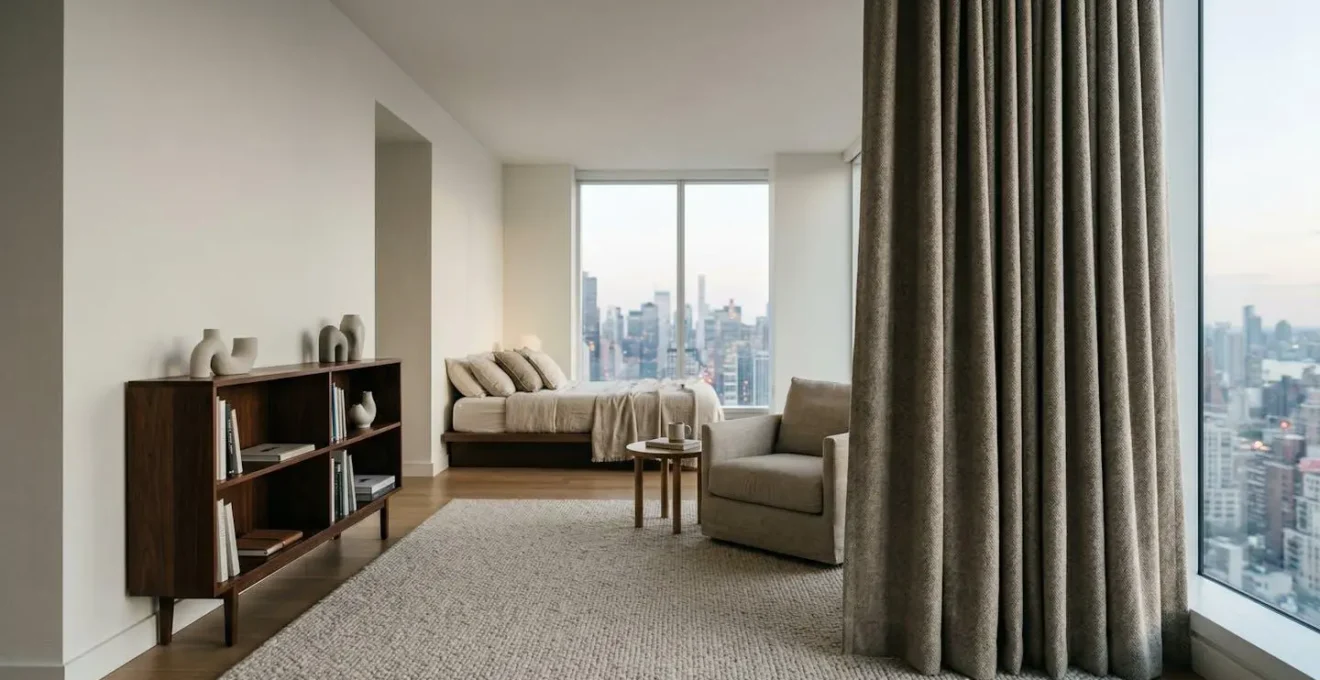
The constant hum of the city isn’t just annoying; it’s a physical stressor you can actively manage by treating your apartment as an acoustic system.
- The most significant noise reduction comes from meticulously sealing air gaps, which act as primary sound leaks.
- Strategically arranging furniture and using heavy textiles leverages the principles of mass and absorption to disrupt sound waves effectively.
Recommendation: Start by performing an “incense smoke test” on your windows and doors; identifying and sealing these leaks offers the highest return on your effort for immediate quiet.
The sudden wail of a siren piercing the night, the low-frequency thrum of traffic that never truly stops—for urban renters, this soundscape is the default. The desire for a quiet sanctuary feels like a luxury reserved for homeowners who can rip out walls and install triple-glazed windows. Common advice often feels inadequate: buy heavy curtains, get a thick rug, maybe a white noise machine. While not wrong, these tips only scratch the surface because they lack the foundational “why.” They are isolated tactics, not a cohesive strategy.
The real solution lies in shifting your perspective. Instead of seeing your apartment as a passive box, you must learn to see it as an acoustic system you can actively manage. This requires thinking like an acoustic engineer, understanding the basic physics of how sound travels, and recognizing that sound is only one part of a larger sensory environment. True peace isn’t just about what you can’t hear; it’s about creating a holistic sensory sanctuary that promotes calm, focus, and restorative sleep.
This guide will deconstruct the problem of urban noise from an engineer’s viewpoint. We will explore the physiological impact of noise, then move to actionable, non-destructive techniques. We’ll analyze how to seal sound’s primary entry points, compare the roles of different materials, and learn to use your existing furniture as an acoustic tool. Finally, we’ll expand the concept of “quiet” to include your visual environment and overall focus, creating a truly serene living space.
This article provides a structured approach to transforming your rented space into a peaceful retreat. The following sections break down the science and strategy behind effective, non-permanent sound management, empowering you to reclaim your quiet without a single nail.
Summary: An Engineer’s Framework for Non-Destructive Apartment Sound Management
- Why Traffic Noise Raises Your Cortisol Levels While You Sleep?
- How to Seal Air Gaps in Windows to Cut Noise by 10 Decibels?
- Heavy Curtains or Acoustic Panels: Which Stops Low-Frequency Hum?
- The Mistake of Masking Noise Too Loudly and Damaging Hearing
- How to Rearrange Furniture to Create a Sound Buffer?
- How to Reclaim 2 Hours of Daily Focus in a Distracted World?
- How to Layer Lighting to Eliminate Harsh Shadows in Your Living Room?
- How to Zone a 400 sq ft Studio to Create a Separate Bedroom Feel?
Why Traffic Noise Raises Your Cortisol Levels While You Sleep?
Your ears don’t have eyelids. While you sleep, your brain continues to process auditory information, distinguishing between benign sounds and potential threats. Persistent, non-rhythmic noises like traffic are interpreted as a continuous, low-level alert. This triggers a physiological stress response, even if you don’t fully wake up. The primary mechanism is the release of stress hormones, most notably cortisol. This nightly elevation of cortisol disrupts sleep architecture, preventing you from reaching the deeper, more restorative stages of sleep. Over time, this chronic activation of your body’s stress system can have significant health consequences.
From an engineering perspective, traffic noise is a complex signal composed of various frequencies, from the low-frequency rumble of truck engines to the high-frequency hiss of tires on wet pavement. This inconsistency is precisely what makes it so disruptive. Research confirms that this isn’t just a feeling of annoyance; it’s a measurable biological event. For instance, traffic noise at night causes stress hormone elevation and oxidative stress, which are linked to an increased risk of cardiovascular disease. Understanding this physiological impact is the first step; it transforms soundproofing from a “comfort” project into an essential act of health preservation.
The goal, therefore, is not to achieve absolute silence—an impractical and often unsettling state—but to reduce the “spikes” in the noise floor. By lowering the overall volume and unpredictability of intrusive sounds, you reduce the stimuli that trigger your brain’s threat-detection system. This allows your body to remain in a parasympathetic (rest-and-digest) state, lowering cortisol and facilitating the deep, restorative sleep necessary for physical and mental health. The following sections will focus on the practical physics of achieving this reduction.
This understanding frames the practical steps not as mere DIY tasks, but as direct interventions to protect your well-being from the constant assault of urban noise.
How to Seal Air Gaps in Windows to Cut Noise by 10 Decibels?
Before investing in any soundproofing product, you must address the path of least resistance for sound: air gaps. Sound energy, much like water, will exploit any crack or opening. A window may have a high-quality, thick pane of glass, but if its frame is not perfectly sealed, its acoustic performance is compromised. In acoustics, this is a critical principle: the overall effectiveness of a barrier is dictated by its weakest point. A tiny gap can transmit a disproportionate amount of sound energy, rendering expensive solutions ineffective.
The physics are unforgiving. In fact, research on acoustic performance shows that a 1% air gap can reduce the maximum sound transmission loss of a wall or window to just 20 decibels, regardless of the quality of the materials used. This means that a hairline crack around your window frame is a sonic superhighway for traffic, sirens, and street noise. Sealing these gaps is the single most cost-effective, high-impact action a renter can take. A 10-decibel reduction is significant, as it is perceived by the human ear as a halving of the sound’s loudness.
To begin, you must become a detective. You need to identify every single point of failure in your window assembly. The most effective method is a simple diagnostic test you can perform yourself, which forms the first step of a systematic sealing process.
As this detailed view shows, the junction between the window frame, the wall, and moving parts is where sound leaks occur. Addressing these with the right materials is crucial.
Your Action Plan: Sealing Windows for Maximum Noise Reduction
- Points of contact: Systematically identify all air gaps using the ‘incense smoke test’. Light an incense stick and move it slowly around the entire perimeter of your window frames; watch for any smoke movement that indicates a draft or air leak.
- Collecte: Thoroughly clean all window frames, sills, and tracks. If present, remove any old, cracked, or compressed weatherstripping.
- Cohérence: Apply removable acoustic caulk (a non-hardening sealant) to fill all static gaps and cracks between the window frame and the wall. This adds mass and closes the leak.
- Mémorabilité/émotion: Install new, high-density foam or rubber weatherstripping along all moving parts of the window, such as where the sash meets the frame, ensuring a tight compression seal when closed.
- Plan d’intégration: Test your results. Use a free decibel meter app on your smartphone to measure the ambient noise level before and after the treatment to quantify the improvement.
By transforming your windows from acoustic liabilities into sealed barriers, you’ve addressed the most critical vulnerability in your apartment’s defense against noise.
Heavy Curtains or Acoustic Panels: Which Stops Low-Frequency Hum?
Once air gaps are sealed, the next step is to manage the sound that travels *through* surfaces like glass and walls. This is where many people consider curtains or acoustic panels, often using the terms interchangeably. From an engineering standpoint, they perform two fundamentally different functions: blocking and absorption. Heavy curtains excel at blocking because they add mass. Acoustic panels excel at absorption, which reduces echo *within* a room. Understanding this distinction is key to choosing the right tool for the job.
Low-frequency noise, like the persistent hum of traffic or a neighbor’s bass, consists of long sound waves with high energy. These waves are difficult to stop and require significant mass to block their transmission. A heavy, dense curtain, often labeled as “soundproof” or “blackout,” acts as a mass-loaded barrier. It physically impedes the sound wave’s ability to travel through the window. Acoustic panels, typically made of porous materials like foam or mineral wool, are designed to trap sound waves (primarily mid-to-high frequencies) and convert their energy into a tiny amount of heat. They are excellent for taming reverberation and making a room sound less “live” and echoey, but they lack the sheer density to be an effective barrier against low-frequency hum transmitting from the outside.
The following table, based on a comparative analysis of acoustic performance, breaks down the core differences in function and application.
| Feature | Heavy Curtains (Mass) | Acoustic Panels (Absorption) |
|---|---|---|
| Primary Function | Blocking sound transmission (STC) | Absorbing internal echo (NRC) |
| NRC Rating | 0.20-0.45 | 0.80-0.95 |
| Low-Frequency Performance | Better (adds mass barrier) | Limited (needs thickness) |
| Best Application | Windows, external noise blocking | Interior walls, echo reduction |
| Installation | Curtain rod (removable) | Wall mounting (semi-permanent) |
| Aesthetics | Wide color/pattern range | Limited neutral colors |
| Cost Range | $30-$300 per panel | $50-$400+ per panel |
For battling low-frequency city hum, a heavy curtain is your first line of defense at a window, while acoustic panels are the tool you use to refine the sound quality inside your now-quieter room.
The Mistake of Masking Noise Too Loudly and Damaging Hearing
After blocking and absorbing sound, the final tactic in an acoustic engineer’s toolkit is masking. This involves introducing a neutral, consistent sound—like white, pink, or brown noise—to cover up intrusive, irregular noises. The principle is based on the “signal-to-noise ratio.” The disturbing siren or slamming door is the “signal.” By raising the “noise” floor with a pleasant, constant sound, the jarring signal becomes less perceptible. However, a common and dangerous mistake is to turn the masking sound up too high in a brute-force attempt to obliterate the external noise.
This approach is counterproductive and harmful. The goal of masking is not to drown out other sounds with sheer volume, but to reduce the contrast between silence and sudden noise. Your brain is less distracted by the absolute level of sound and more by abrupt changes. The ideal masking volume is one that is just loud enough to make those sudden noises blend into the background. Turning it up higher doesn’t just negate the calming effect; it introduces a new source of noise pollution and puts your hearing at risk.
Audiologists have clear guidelines on this. Prolonged exposure to any sound, even one perceived as pleasant like a waterfall, can cause hearing damage if it’s too loud. According to Baptist Health audiology guidelines, for adults, safe masking volume is below 70 decibels; prolonged exposure above 85 decibels (the level of a noisy restaurant or heavy traffic) for more than 8 hours can cause permanent hearing damage. For context, 70 dB is comparable to the sound of a shower. A safe and effective masking level is often closer to 50-65 dB, akin to a quiet conversation or moderate rainfall. Always use the “arm’s length conversation test”: if you have to raise your voice to speak to someone near the sound machine, it is unequivocally too loud.
Effective sound masking is a precision tool, not a sledgehammer. Use it to gently smooth the rough edges of your auditory environment, not to create another wall of sound.
How to Rearrange Furniture to Create a Sound Buffer?
Your furniture is not just functional or decorative; it is a collection of acoustic assets waiting to be deployed. Every object in your apartment has properties of mass, absorption, or diffusion. By strategically rearranging these items, you can create effective sound buffers and significantly alter the acoustic profile of your space without spending a dime. The core principles are to use mass to block sound and soft surfaces to absorb it.
The most effective piece of acoustic furniture is a large, fully-stocked bookcase. When placed against a wall facing the street or a noisy neighbor, it acts as a substantial mass barrier. The combination of the dense wood or MDF structure and the varied shapes and densities of the books inside is excellent at disrupting and blocking a wide range of sound frequencies. A heavy wardrobe or dresser filled with clothes can serve a similar function. The key is to create a dense, multi-layered barrier between you and the noise source.
Beyond simple blocking, you can create “acoustic zones.” By positioning large, soft furniture like an upholstered sofa or plush armchairs, you can create a perimeter around your bed or workspace. These items act as giant sound absorbers, soaking up sound waves that make it past your initial defenses. Furthermore, adding thick area rugs with dense pads underneath is critical. This combination not only absorbs airborne sound but also helps to dampen structural vibrations that travel through the floor, such as footfalls from above. Finally, avoid creating large, hard, parallel surfaces (like the back of a wardrobe facing a bare wall), as this can create unpleasant standing waves or echoes. Use tall plants or angled art to break up these surfaces and diffuse sound.
By viewing your layout through an acoustic lens, you can transform your furniture from simple objects into a sophisticated, multi-layered sound-dampening system.
How to Reclaim 2 Hours of Daily Focus in a Distracted World?
Soundproofing is not just for sleep; it is a critical tool for deep work. In a world of constant notifications and distractions, the urban environment adds a layer of auditory chaos that fragments attention and drains cognitive resources. Reclaiming focus in a noisy apartment requires more than just willpower; it demands the creation of a deliberate “deep work sanctuary.” By applying acoustic principles, you can build a ritual that signals to your brain it’s time to concentrate, effectively reclaiming hours of lost productivity.
The foundation of this ritual is creating a sharp, immediate transition from the chaotic external world to your controlled internal one. This is achieved through a multi-sensory process that systematically reduces unwanted input. It’s not about achieving total silence, but about establishing a predictable and stable sensory baseline that allows your brain to stop monitoring the environment for threats and distractions and fully engage with the task at hand. This process can be broken down into a few key steps.
First, you must isolate your auditory sense. This is where noise-cancelling headphones become an indispensable tool for the urban knowledge worker. They create an immediate and powerful barrier. Second, you immerse yourself in a focus-specific soundscape, like brown noise (excellent for masking low-frequency rumbles) or a 40Hz binaural beat track, played at a safe, low volume (50-60 dB). This replaces the unpredictable city noise with a constant, non-distracting auditory texture. Third, you add a visual signal, like switching on a dedicated desk lamp. This final step reinforces the ritual, creating a powerful psychological association between this specific set of sensory conditions and a state of deep focus. By consistently following this protocol, you train your brain to enter a productive flow state on command.
This disciplined approach transforms a noisy apartment from a place of constant interruption into a high-performance environment for deep work and creative thought.
How to Layer Lighting to Eliminate Harsh Shadows in Your Living Room?
An environment free from auditory chaos can still feel unsettling and distracting if it is visually harsh. Just as abrupt noises fragment attention, harsh shadows and uneven lighting create a form of “visual noise” that contributes to a sense of unease. Creating a true sensory sanctuary—a space that feels calm and restorative—requires extending acoustic principles to your visual environment. The goal is to smooth the “visual landscape” just as you smoothed the soundscape.
Harsh shadows are the visual equivalent of a sudden, loud noise. They are created by single, bright, overhead light sources that produce high contrast between light and dark areas. This can make a space feel smaller, less welcoming, and even subtly stressful. Layering light, much like layering sound, is the solution. This involves using multiple light sources at different heights and intensities to create a soft, balanced, and inviting atmosphere. The three primary layers are: ambient (overall illumination, often from a ceiling fixture with a diffuser), task (focused light for activities like reading), and accent (light that highlights architectural features or art).
By combining these layers, you can wash walls with soft light, eliminate dark corners, and reduce the stark contrast that creates harsh shadows. Using warm-toned bulbs (around 2700K) further enhances the feeling of calm and comfort. This holistic approach, which considers how a space *feels* as much as how it sounds, is the hallmark of sophisticated design.
By using acoustic-improving techniques in spaces, you create a space that feels more grounding and lends itself to focused work and intimate conversations. Minimizing hard surfaces improves acoustics and minimizes echoes.
– Kirsten Horton, Acoustics-focused interior designer interview with Apartment Therapy
This attention to visual comfort completes the transformation of your apartment from a simple dwelling into a holistic environment engineered for well-being.
Key Takeaways
- The highest-impact soundproofing action is to meticulously find and seal all air gaps around windows and doors, as they transmit the most sound.
- Use heavy, dense objects (like full bookcases and thick curtains) for their mass to block incoming noise, and soft, porous items (rugs, sofas, acoustic panels) for their absorption to control echo inside.
- Effective sound masking uses low, consistent volume (50-65 dB) to reduce the contrast of sudden noises, not to drown them out; high volumes can damage hearing.
How to Zone a 400 sq ft Studio to Create a Separate Bedroom Feel?
In a studio apartment, the ultimate challenge is creating separation. This is not just a visual problem but an acoustic one. Without physical barriers, sound—whether from the street or your own kitchen—permeates the entire space, preventing the creation of a distinct sanctuary for sleep. The solution lies in “acoustic zoning”: using multi-functional dividers that provide both visual and auditory separation, training your brain to associate a specific area with rest.
A classic and effective tool is a large, open-backed shelving unit (like an IKEA KALLAX). When strategically filled, it becomes a powerful acoustic device. By arranging a checkerboard pattern of dense items (heavy books for mass) and soft items (fabric storage bins for absorption), you create a divider that both blocks and soaks up sound. It diffuses sound waves, preventing the flat, echo-promoting surfaces of a solid wall, while still allowing light to pass through, keeping the space from feeling claustrophobic.
Another highly effective and renter-friendly solution is a ceiling-mounted track for heavy, floor-to-ceiling curtains. When made from sound-dampening fabric, this creates a flexible “wall” that can be drawn to enclose the bedroom zone at night. This provides a significant level of sound absorption and blocking, and the physical act of drawing the curtain becomes a powerful ritual to signal the transition to sleep. This zoning is reinforced by placing a thick area rug under the bed area to absorb footstep sounds and by using a dedicated white noise machine *within* the sleep zone to create a consistent, localized soundscape. This combination of physical division and sensory cues is how you engineer the “feel” of a separate bedroom.
Your journey to a quieter home starts not with a purchase, but with a new perspective. Begin today by auditing your space with the principles of an acoustic engineer, transforming it one decibel at a time.