
In summary:
- Stop seeing pedestrianization as a threat; data shows it’s a financial opportunity where walkers outspend drivers.
- Your business must shift from a “destination” model (for cars) to a “discovery” model (for pedestrians).
- Mastering the new sidewalk environment—from window displays to deliveries—is a tactical challenge, not an impossible one.
- Collaboration with neighboring businesses is no longer a choice; it’s a core survival strategy for logistics and marketing.
The notice arrives, taped to a lamppost or buried in a city council email. Your street is going car-free. For many retailers, the first reaction is a cold wave of panic. Your entire business model, built on visibility from the road, convenient parking, and the quick “pop-in” customer, feels like it’s about to shatter. You’re not just losing a traffic lane; you feel like you’re losing your lifeline. The city planners and consultants will present cheerful charts about community and quality of life, but they don’t have to make payroll. They don’t understand the visceral fear of watching your regulars struggle to find parking a block away or the logistical nightmare of restocking your inventory without street access.
The common advice is often frustratingly vague: “embrace the change,” “improve your curb appeal,” “engage the community.” But this isn’t about positive thinking. It’s about survival. The truth is, your old playbook is obsolete. The customer who drives is a fundamentally different creature from the customer who walks. But what if the key to survival isn’t just about weathering this storm, but about mastering a new science of retail? What if pedestrianization isn’t the end, but the beginning of a more profitable, resilient business model? This guide is your tactical manual for that first, crucial year. We won’t just tell you *that* it can be better; we will show you *how* to make it better by fundamentally re-engineering your approach to your space, your customers, and your operations.
This article provides a step-by-step survival plan, breaking down the essential shifts in strategy you need to make. We’ll explore the new economics of foot traffic, tactical optimizations for your physical space, and the collaborative mindset required to thrive in this new urban landscape. Explore the sections below to build your resilience plan.
Summary: Surviving the First Year of Street Pedestrianization
- Why Foot Traffic Spends 20% More Than Drive-By Traffic?
- How to Optimize Your Window Display for Slow-Walking Pedestrians?
- Outdoor Seating or Expanded Inventory: Which Uses the Sidewalk Best?
- The Delivery Nightmare: How to Restock Without Street Access?
- When to Launch Happy Hour: Aligning with Pedestrian Flow Peaks
- How to Solve the Last-Mile Delivery Problem in High-Density Zones?
- How to Communicate Social Values Without Being Accused of Woke-Washing?
- How to Adopt Corporate Minimalism to Reduce Decision Fatigue?
Why Foot Traffic Spends 20% More Than Drive-By Traffic?
The core fear of pedestrianization is the loss of the drive-by customer. It’s a logical fear, but it’s based on an outdated assumption: that drivers are your most valuable customers. The data tells a radically different story. A pedestrian or cyclist doesn’t just represent a single purchase; they represent a pattern of behavior that is fundamentally more valuable to a local retail ecosystem. They move slower, see more, and are less focused on a single destination. Research consistently shows that while they may spend less per trip, they visit far more frequently, ultimately outspending drivers over time. This isn’t just theory; it’s a proven economic principle.
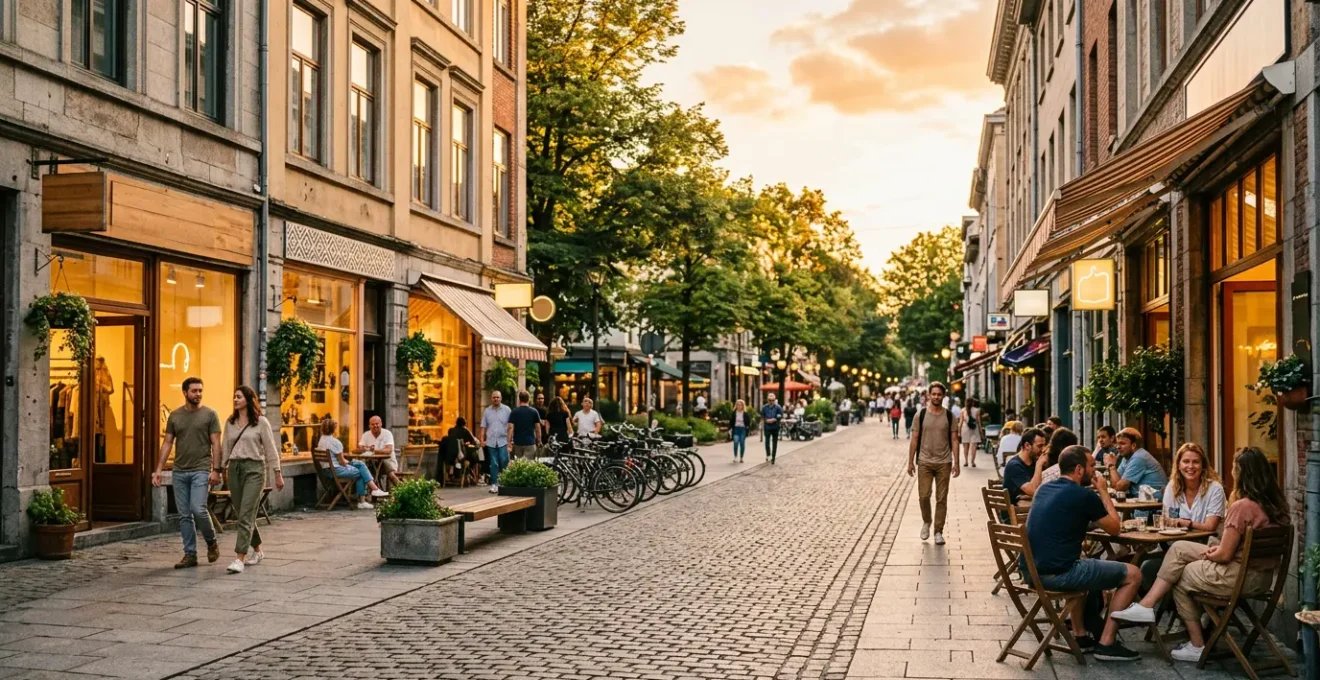
The transformation of urban spaces during the COVID-19 pandemic provided a large-scale, real-world experiment. In New York City, restaurants and bars on streets converted to “Open Streets” saw their sales perform 19% higher than pre-pandemic levels. Meanwhile, nearby businesses on traditional streets saw a 29% decrease. This wasn’t a fluke. The pedestrianized streets became destinations in themselves, fostering an environment where people lingered. Storefront vacancy rates on these open streets were also significantly lower than the citywide average, proving that foot traffic creates a more resilient and attractive commercial corridor. The shift from car traffic to foot traffic isn’t a downgrade; it’s a filter that brings you customers who are more engaged, more frequent, and ultimately, more profitable.
Case Study: The NYC Open Streets Turnaround
During the COVID-19 crisis, New York City’s temporary open streets initiative offered a stark contrast in retail fortunes. A 2024 Comptroller study revealed a powerful economic divergence: restaurants and bars on these pedestrian-friendly streets saw sales climb 19% above their pre-pandemic figures. In stark contrast, businesses in adjacent areas without open streets experienced a devastating 29% sales drop. This data highlights a critical lesson: creating spaces for people to walk and linger directly translates into commercial vitality and business resilience.
For your business, this means the first year is about recalibrating your metrics. Don’t mourn the loss of a parking spot; celebrate the gain of a thousand potential impressions from passersby. Your primary goal is no longer to be a convenient stop for a car, but an irresistible discovery for a person on foot. This is a fundamental shift from destination-driven commerce to discovery-driven commerce.
How to Optimize Your Window Display for Slow-Walking Pedestrians?
In a car-centric world, your most important marketing tool is a large sign. In a pedestrianized zone, your most valuable real estate is the first eight feet of your storefront, especially your window. A driver sees your store for 3 seconds; a walker might give you 30. Your window display is no longer a static poster; it’s a multi-layered narrative designed to engage a slow-moving audience at different distances. This requires adopting the “3-Foot, 30-Foot Rule.” From 30 feet away, you need a bold focal point—a splash of color, a dramatic shape, an intriguing mannequin—to hook their attention and alter their path. This is your long-range signal.
As they approach, the 3-foot view comes into play. This is where you reward their curiosity with detail, texture, and storytelling. They should be able to see the quality of a product, read a clever bit of copy, or be charmed by a small, delightful detail. This is about creating depth and intrigue, not just packing the window with merchandise. Use layers—foreground, mid-ground, and background elements—to create a sense of dimension that draws the eye in. The goal is to make someone pause, lean in, and then feel compelled to step inside. Your window is now the first chapter of your store’s story, and it has to be compelling enough to make people want to read the rest.
This paragraph introduces the complex concept of layered visual merchandising. To better understand this, the illustration below breaks down how to construct a display that works at multiple distances.
As this visual representation shows, each layer has a distinct job. The background provides the initial hook, the mid-ground tells the product story, and the foreground offers the tactile details that close the deal. This strategic layering transforms a simple window into a powerful customer acquisition tool. It’s a silent salesperson working for you 24/7.
Your Action Plan: Designing a Pedestrian-Optimized Window
- Start with a Story: Don’t just display products. Build your display around a theme or a narrative (e.g., “A Day at the Beach,” “Urban Explorer”) that creates an emotional connection.
- Create a Focal Point: Use a single, distinctive design element—a large prop, a bold graphic, or a dramatic lighting effect—to draw the eye from 30 feet away and make people curious.
- Layer the Space: Use overlapping elements at different depths. Place small, detailed items in the foreground and larger, simpler shapes in the background to create visual intrigue.
- Balance the Visuals: Arrange elements to create a balanced, aesthetically pleasing composition. Use the rule of thirds and negative space to guide the customer’s focus to key products.
- Master Your Lighting: Use adjustable spotlights to highlight key products and ensure the display is well-lit and dramatic, especially at night. Your lighting should adapt to the time of day.
Outdoor Seating or Expanded Inventory: Which Uses the Sidewalk Best?
With the cars gone, the street and sidewalk in front of your store are no longer just a thoroughfare; they are your new frontier. This newly available space presents a critical strategic choice: do you use it to expand your inventory footprint or to create an experience? For most retailers, the answer is clear: experience wins over inventory. Spilling more racks of merchandise onto the sidewalk can look cluttered and desperate. Creating a “parklet” or a small seating area, however, transforms your storefront from a place of transaction into a place of community. It signals that you are a part of the neighborhood fabric, not just a box that sells things.
This isn’t just a feel-good strategy; it’s a financially sound one. Well-designed parklets act as a powerful magnet for foot traffic. They give people a reason to stop, to rest, and to observe. While they are sitting, your storefront is in their direct line of sight. They become a captive audience. Studies have shown this directly impacts the bottom line. A Philadelphia study found that businesses with well-placed parklets reported up to a 20% increase in revenues. This space becomes a social anchor that not only enhances the street’s atmosphere but also drives qualified leads directly to your door. It turns the “curb” into a valuable, revenue-generating asset.
Case Study: Chicago’s “People Spots” Program
Chicago’s innovative “People Spots” program empowers local businesses to convert parking spaces into seasonal public amenities like seating and planters. A 2014 study of the program revealed a significant uptick in foot traffic for adjacent businesses. Owners reported that these spots helped activate retail corridors, with some new entrepreneurs specifically seeking locations where they could implement a People Spot. It shows that investing in public space isn’t just a civic good; it’s a powerful tool for economic development and a way to make a neighborhood more desirable for both customers and new businesses.
The choice isn’t really between seating and inventory; it’s between two different mindsets. One sees the sidewalk as storage. The other sees it as a stage. In the new pedestrian-first world, the retailers who learn to be good stage directors will be the ones who thrive.
The Delivery Nightmare: How to Restock Without Street Access?
Let’s be blunt: this is the most legitimate and immediate fear for any retailer facing pedestrianization. The romantic vision of happy pedestrians strolling with shopping bags evaporates when you have a 500-pound pallet of inventory that needs to get from a truck to your stockroom. If you don’t solve this logistical puzzle, your business will grind to a halt. The key is to shift from a mindset of “access” to one of “logistical choreography.” You can no longer rely on a truck pulling up to your front door whenever it arrives. Your restocking process now needs to be planned with military precision.
The first step is to become a master of timing. Work with your suppliers to schedule deliveries for early morning or late-night hours when the street has fewer pedestrians. This often requires renegotiating terms or even finding new, more flexible suppliers. The second step is to rethink the vehicle. Can large shipments be broken down at a nearby staging area and brought the last 100 yards via electric cargo bikes or heavy-duty dollies? This “micro-logistics” approach is essential. The third, and most critical, step is collaboration. You are not the only business on the block facing this problem. Form a merchant association to lobby the city for designated commercial loading/unloading zones at the ends of the pedestrianized street, with clear time windows. Pool your resources to hire a shared logistics team to manage the “last 50 feet” for everyone. The delivery nightmare is real, but it is solvable through planning, technology, and, above all, cooperation.
Imagine this scenario: your street’s merchant association collectively leases a small garage space two blocks away. This becomes the “neighborhood logistics hub.” All large trucks deliver there. A dedicated team, funded by the association, then uses electric carts to perform just-in-time deliveries to each store throughout the day. This not only solves the access problem but also reduces truck noise and congestion on the main street, further enhancing the pedestrian experience. This is the kind of creative, collective thinking required to survive and thrive.
When to Launch Happy Hour: Aligning with Pedestrian Flow Peaks
In the old world, your “peak hours” were likely tied to the rhythms of car traffic—the evening commute, the weekend rush. In a pedestrianized zone, these rhythms are replaced by something more subtle and varied: the rhythm of the street. Your new job as a retailer is to become an urban anthropologist, observing and mapping the flow of people outside your door. The morning rush of commuters, the mid-day lunch-seekers, the afternoon dog-walkers, the evening strollers, and the late-night revelers—each represents a distinct customer segment with different needs and a different propensity to spend.
Launching a happy hour, a special promotion, or a sidewalk sale at the wrong time is like fishing in an empty pond. Your task is to gather your own street-level intelligence. This doesn’t require expensive software. It requires a chair, a notebook, and a clicker counter. Spend a few days manually tracking the volume and *type* of pedestrians at different hours. Is there a surge of office workers between 12:00 and 1:00 PM? That’s your window for a “quick lunch” special. Does the street come alive with young couples after 7:00 PM? That’s the time for a two-for-one offer or a romantic window display. This is about data-driven decision-making on the most micro-level. You are no longer guessing; you are responding to the observable, predictable pulse of your specific location.
Observing the rhythm of the street is an active process of intelligence gathering. The image below captures the essence of this hands-on, tactical approach to understanding your new customer base.
This simple act of counting and observing is one of the most powerful strategic moves you can make in your first year. It replaces assumptions with facts. Aligning your business operations—from staffing levels to promotional timing—with these newly discovered pedestrian peaks is the secret to capturing the full economic potential of your new environment. You are not just on a street; you are part of a living, breathing ecosystem. Learn its rhythms, and you will learn how to thrive within it.
How to Solve the Last-Mile Delivery Problem in High-Density Zones?
While Section 4 dealt with the immediate, tactical challenge of getting goods *into* your store, the “last-mile problem” in a broader sense also refers to getting goods *out* to your customers. In a high-density, pedestrianized zone, this is both a challenge and a massive opportunity. Customers who walk or bike to your area may not want to carry large purchases home. If you don’t offer a convenient delivery solution, you will lose sales. The solution, once again, lies in seeing infrastructure not as a fixed reality, but as a collaborative opportunity.
Individual businesses trying to set up their own delivery systems is inefficient and costly. The truly strategic solution is collaborative. Retailers on a block or in a district must band together to create a shared last-mile delivery infrastructure. This could take the form of a partnership with a local cargo-bike delivery service, offering a unified, low-cost delivery option for all participating stores. It could also mean co-funding a “neighborhood concierge” service, where a central kiosk holds purchases for customers to pick up later, or arranges for them to be delivered.
The success of such initiatives hinges on the ability of businesses and the city to work together to repurpose public space for shared benefit. A powerful model for this kind of collaboration can be seen in San Francisco’s Parklet Program. While focused on creating public amenities, its core principle is directly applicable here. The program shows that when businesses and communities are empowered to creatively repurpose curbside infrastructure, the entire neighborhood benefits. It requires documented support and a collaborative application process, fostering a sense of shared ownership. This is the exact mindset needed to solve the last-mile problem: see the street not as a series of private storefronts, but as a shared platform for innovation.
Model for Collaboration: San Francisco’s Parklet Program
San Francisco’s approach to parklets demonstrates how partnerships between the city and local businesses can transform public space. The program requires merchants to gather neighborhood support, ensuring that the new use of the curb—whether for seating, landscaping, or bike parking—is a community-driven decision. This process of co-design and shared investment in public infrastructure provides a blueprint for how retailers in a pedestrianized zone can collaborate to solve larger problems, such as creating a shared last-mile delivery system.
How to Communicate Social Values Without Being Accused of Woke-Washing?
When your street becomes pedestrianized, you have been handed a powerful, authentic story to tell. But many businesses hesitate, fearing they’ll be accused of “woke-washing” or jumping on a bandwagon. The key is to avoid vague, corporate-speak about “sustainability” and instead focus on the tangible, universally understood benefits that your new street environment provides. Your communication shouldn’t be about abstract values; it should be about concrete improvements to the community’s quality of life that your business is now a part of.
As experts from ScienceDirect have pointed out, the goals of pedestrianization are practical and desirable for everyone. It’s not a political statement; it’s a design choice with clear objectives. Your communication should anchor itself in these realities. Instead of saying “we support green initiatives,” say “we love being on a street where you can hear birds instead of car horns.” Instead of “we value community,” say “we’re proud to be a place where neighbors can stop and chat on our new sidewalk bench.” This approach is authentic because it’s rooted in the direct, observable experience of your customers and staff.
Pedestrianization usually aims to provide better accessibility and mobility for pedestrians, to enhance the amount of shopping and other business activities in the area or to improve the attractiveness of the local environment in terms of aesthetics, air pollution, noise and crashes involving motor vehicles with pedestrians.
– ScienceDirect Topics, Pedestrian Zone Overview – Sustainable Urban Mobility Pathways
The danger comes when communication is disconnected from action, or when it ignores the legitimate concerns of the business community. The pedestrianization of Montreal’s Sainte-Catherine Street serves as a powerful cautionary tale. While foot traffic and retail eventually recovered spectacularly, the initial rollout was marred by a failure to communicate with and listen to merchants. The city’s mistake wasn’t pedestrianizing the street; it was failing to build trust and bring business owners into the process from the start. The lesson is clear: authentic communication is a two-way street. It involves celebrating the shared benefits while also acknowledging the challenges and working collaboratively to solve them.
Key takeaways
- Embrace the New Economics: Stop fearing the loss of drivers. Data conclusively shows that pedestrians and cyclists are more frequent visitors and ultimately represent a more resilient customer base.
- Your Storefront is a Stage: In a pedestrian zone, your window display and sidewalk are your primary marketing tools. Master the art of grabbing attention from 30 feet away and rewarding curiosity from 3 feet away.
- Collaboration is Survival: The biggest challenges of pedestrianization—logistics, deliveries, marketing—cannot be solved alone. Forging a strong merchant association is no longer optional; it’s a critical operational necessity.
How to Adopt Corporate Minimalism to Reduce Decision Fatigue?
The first year of pedestrianization is chaotic. You’re reinventing your logistics, re-learning your customer’s habits, and redesigning your physical space. The sheer volume of new decisions can be overwhelming, leading to crippling decision fatigue. In this high-stress environment, one of the most powerful survival strategies is to adopt a philosophy of corporate minimalism. This isn’t about stark, empty spaces; it’s about making deliberate, strategic choices to simplify your operations, your offerings, and your message. It’s about doing fewer things, but doing them better.
This minimalist approach should start with your physical space. A pedestrian who is constantly bombarded with visual information on a busy street craves clarity. A cluttered, overstuffed store is stressful to enter. A clean, well-curated space with a clear focus is an oasis. As the Shopify Retail Team advises, the goal is to highlight quality, not quantity. Resisting the temptation to fill every inch of space is a sign of confidence. It communicates that you believe in the quality of your key products.
Minimalist displays focus on a clean, simple display with a few key products to draw attention to their quality and design. Resist the temptation to fill up a window to maximize the space.
– Shopify Retail Team, 20 Retail Window Display Ideas & Examples
This philosophy extends to your product line and your promotions. Instead of running a dozen different weak promotions, focus your energy on one or two high-impact events that are perfectly aligned with the rhythm of your street. Instead of carrying a sprawling inventory, focus on being the absolute best at a smaller, more curated selection. By reducing the number of choices you have to make as a manager, you free up the mental bandwidth to focus on the things that truly matter in this new environment: observing your customers, talking to your neighbors, and creatively adapting to the pulse of your new street. Minimalism isn’t just an aesthetic; it’s a powerful tool for maintaining focus and sanity during a period of intense change.
The transition is challenging, but it is a solvable problem. It demands a shift in mindset from passive victim to active strategist. Start today by observing your street not as it was, but as it is now. Your survival depends on your ability to adapt, and your future success will be built one curious, engaged pedestrian at a time.