
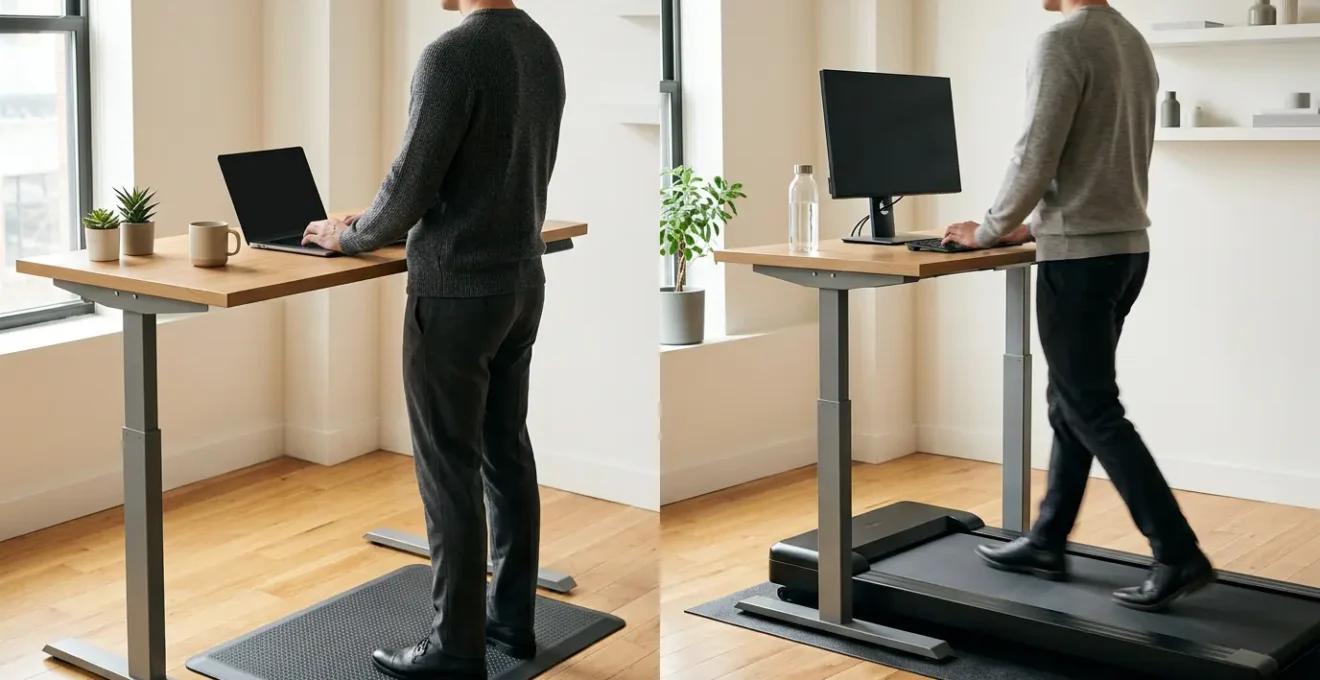
The debate between standing and treadmill desks misses the point. Your morning workout can’t undo 8 hours of sitting, not because you aren’t burning enough calories, but because inactivity shuts down key metabolic enzymes. The solution isn’t just to stand, but to use structured movement and proper biomechanics to continuously send the right physiological signals to your body, turning your workstation into a tool for metabolic health and sustained focus.
For the health-conscious office worker, the daily routine can feel like a paradox. You crush a 5 AM workout, only to spend the next eight hours chained to a screen. You feel productive, yet an underlying sense of sluggishness creeps in by midafternoon. This isn’t a failure of discipline; it’s a physiological reality. The modern workplace, even for the most active individuals, has become a hotbed for sedentary risk, turning many of us into “active couch potatoes.”
The common response has been a widespread adoption of standing desks, touted as the simple antidote to the “sitting disease.” But simply swapping your chair for a standing position is like buying a high-performance race car and never taking it out of first gear. The real benefits don’t come from the static act of standing but from understanding the physiological principles of movement and how to integrate them intelligently into your workday. It’s not about standing vs. walking; it’s about combating inactivity.
This is where a kinesiologist’s perspective becomes crucial. We’re moving beyond generic advice and dissecting the biomechanics of the active workstation. This guide isn’t just about burning a few extra calories. It’s about reactivating your metabolism, improving your posture, preventing chronic pain, and structuring your day for both peak physical health and cognitive performance. We will explore the science behind why prolonged sitting is so detrimental, how to use your desk correctly, and how to create a rhythm of movement that truly counteracts the negative effects of a desk job.
To navigate this topic, we will explore the key physiological and practical aspects of creating a truly active workday. This article breaks down the science, the common mistakes, and the actionable strategies you can implement immediately.
Summary: A Kinesiologist’s Guide to Active Workstations
- Why Sitting for 6 Hours Cancels Out Your Morning Jog?
- How to Transition to a Standing Desk Without Back Pain?
- Fidgeting or Walking: Which Non-Exercise Activity Thermogenesis (NEAT) is Better?
- The “Leaning” Mistake That Ruins the Benefits of Standing
- How to Use the 52/17 Rule to Balance Focus and Movement?
- How to Spot the 5 Stages of Burnout Before It’s Too Late?
- Hiking Boots or Trail Runners: Which Footwear Prevents Injuries on Rocky Terrain?
- How to Spot the 5 Stages of Burnout Before It’s Too Late?
Why Sitting for 6 Hours Cancels Out Your Morning Jog?
The concept of the “active couch potato” is a frustrating reality for many office workers. You meet the recommended guidelines for weekly exercise, yet your health markers tell a different story. This isn’t a myth; research on active couch potatoes reveals that individuals can show elevated blood sugar and cholesterol levels despite being physically active. The culprit is the long, uninterrupted block of sedentary time that follows the workout. Your morning jog is beneficial, but it cannot grant you metabolic immunity from the physiological consequences of sitting for the rest of the day.
The primary mechanism behind this phenomenon involves a crucial enzyme called lipoprotein lipase (LPL). Think of LPL as a gatekeeper that sits on the walls of your blood vessels, grabbing fat molecules (triglycerides) from your bloodstream to be used for energy by your muscles. When you are active, your LPL is working overtime. When you sit, it effectively goes to sleep. The impact is drastic and immediate.
From a kinesiological standpoint, the large muscles of your legs and glutes are metabolic powerhouses, rich in LPL. When you sit, these muscles are completely disengaged. As a result, a staggering 90-95% of muscle lipoprotein lipase activity is suppressed. This means fat circulates in your bloodstream for longer, contributing to the very health risks you exercise to avoid. Your one-hour workout simply cannot compensate for seven hours of deactivated metabolic machinery.
Therefore, the goal is not just to exercise more, but to interrupt sedentary time frequently to keep these critical metabolic pathways switched on throughout the day.
How to Transition to a Standing Desk Without Back Pain?
The number one mistake people make when transitioning to a standing desk is going all-in from day one. They stand for hours, pushing through the initial discomfort, only to end up with debilitating lower back pain. This happens because your postural muscles, particularly the erector spinae, glutes, and core, lack the endurance for prolonged standing. Like any muscle group, they need to be trained progressively. Forcing them into a marathon on the first day is a recipe for strain and injury.
Proper ergonomic alignment is non-negotiable. Your body should form a straight line from your ear to your shoulder, hip, and ankle. This requires conscious effort to avoid common compensatory patterns like slouching or pushing your hips forward. Your desk and monitor height must be adjusted to facilitate this posture, ensuring your elbows are at a 90-degree angle and your wrists are flat. The goal is to let your skeleton bear the load, not your soft tissues.
This image demonstrates the ideal alignment, focusing on a neutral spine and proper limb positioning to minimize strain.
As you can see, maintaining a natural S-curve in the spine while keeping your joints “stacked” is crucial. This alignment activates your core and gluteal muscles, turning standing into a low-level active state rather than a passive, stressful one. To achieve this, a structured, phased approach is essential.
Your Action Plan: Ergonomic Setup Audit
- Points of contact: List all your physical interaction points with your workstation (chair, desk, monitor, keyboard, mouse, floor).
- Collecte: Inventory your current setup. Is your monitor at eye level? Are your elbows at 90 degrees? Are your feet flat on the floor or on a footrest?
- Coherence: Confront your setup with ergonomic principles. Is your posture neutral or are you compensating with a forward head or rounded shoulders?
- Mémorabilité/émotion: Does your setup encourage movement or lock you into one position? An anti-fatigue mat, for example, encourages micro-movements.
- Plan d’intégration: Identify one or two key adjustments to make this week (e.g., raise monitor with books, adjust chair height) and set a timer to alternate positions.
By gradually increasing your standing time and prioritizing perfect form, you allow your body to adapt, build endurance, and reap the long-term benefits without the pain.
Fidgeting or Walking: Which Non-Exercise Activity Thermogenesis (NEAT) is Better?
Non-Exercise Activity Thermogenesis (NEAT) is the energy expended for everything we do that is not sleeping, eating, or sports-like exercise. It includes a wide spectrum of activities, from typing and fidgeting to pacing and walking to the water cooler. For the desk-bound professional, maximizing NEAT is the single most powerful tool for combating the metabolic slowdown of a sedentary job. It represents the hundreds of calories that separate a lean, active individual from a sedentary one, even if their formal exercise routines are identical.
The question then becomes: are all forms of NEAT created equal? Is tapping your foot under the desk as good as taking a slow walk on a treadmill desk? From a caloric expenditure perspective, the answer is a resounding no. While any movement is better than none, there is a clear hierarchy of effectiveness. Fidgeting is a form of low-level muscle activation that does provide a metabolic boost over static sitting.
However, when compared to purposeful, whole-body movement, its impact is minimal. The data makes this distinction clear. A foundational Mayo Clinic study measuring NEAT found that fidgeting while seated increased energy expenditure by about 54% over resting, whereas walking at a slow pace of 1 mph (1.6 km/h) increased it by 154%. This demonstrates that engaging the large muscle groups of the legs and core through ambulation provides a significantly greater metabolic return. A treadmill desk, therefore, offers a superior platform for maximizing NEAT throughout the workday.
While you shouldn’t stop fidgeting, prioritizing opportunities for slow, consistent walking will yield far greater results in your quest to increase daily energy expenditure and improve metabolic health.
The “Leaning” Mistake That Ruins the Benefits of Standing
You’ve successfully transitioned to a standing desk, but after an hour, you find yourself propped on one hip, with one leg doing all the work. This is the “leaning” or “hip-hitching” mistake, a subtle form of postural compensation that your body uses to conserve energy. While it might feel relieving in the moment, this habit effectively negates many of the benefits of standing. It deactivates your core, disengages your gluteal muscles, and places asymmetrical stress on your spine, hips, and knees.
From a biomechanical perspective, leaning is a surrender. Instead of using your muscles to actively support your posture, you’re relying on passive structures like ligaments and joints to hang from. This not only increases the risk of musculoskeletal imbalances and pain but also turns “standing” back into a metabolically passive activity. You’ve stopped signaling your core and leg muscles to fire, which is the whole point of getting out of the chair.
The solution is to cultivate “active standing.” This involves maintaining an even weight distribution between both feet and making frequent, subtle micro-movements. Think of it as a continuous, gentle shifting of weight from side to side or from the balls of your feet to your heels. Using an anti-fatigue mat can greatly encourage this, as its compliant surface provides sensory feedback and makes micro-movements more comfortable.
This image highlights the engagement at the foundation of your stance. Active standing requires conscious engagement of the small muscles in your feet and lower legs, which in turn helps stabilize your hips and spine. It’s about staying in a state of dynamic balance rather than locking into a static, misaligned position.
By consciously practicing active standing and avoiding the lean, you ensure that you are truly using your muscles, maintaining spinal health, and maximizing the metabolic benefits of your time on your feet.
How to Use the 52/17 Rule to Balance Focus and Movement?
The 52/17 rule, which suggests working in focused 52-minute blocks separated by 17-minute breaks, is often touted as a productivity hack. From a kinesiologist’s perspective, its true genius lies in its alignment with the body’s natural ultradian rhythms and its power as a framework for integrating movement. These natural cycles of energy and focus mean that you can’t maintain high-level concentration for hours on end. The 52/17 rule provides a structured way to work *with* this biology, using the 17-minute break as a dedicated “metabolic reset.”
This regular alternation between sitting/standing and active breaks is not just good for focus; it’s a powerful strategy for preventing musculoskeletal pain. The simple act of changing your posture frequently is key. In fact, a 2018 study in Applied Ergonomics showed that patients using sit-stand desks with counseling on sedentary behavior experienced a 50% decrease in low back pain intensity. The 52/17 rule provides the perfect schedule to enforce this pain-reducing alternation.
The key is to make those 17-minute breaks active and purposeful. Instead of scrolling through your phone, use this time for a “movement snack.” Here is a menu of options to choose from based on your needs:
- After deep focus work: Take a slow walk, preferably outside. This engages diffuse-mode thinking, allowing your brain to process information in the background and often leading to “aha” moments.
- After a block of meetings: Perform mobility work and stretches focusing on the neck, shoulders, and hips to counteract “Zoom posture.”
- During phone calls: Use this time to pace or walk slowly on a treadmill desk. Low-cognitive load tasks are perfect for pairing with low-intensity movement.
- Between creative tasks: Combine a walk with sun exposure to boost both mood and vitamin D synthesis, further enhancing well-being.
- General Guideline: Even without the 52/17 rule, aim to alternate between sitting and standing every 30 minutes for optimal results in managing pain and energy levels.
By adopting this rhythm, you transform your workday from a static marathon into a series of dynamic sprints, optimizing both your cognitive output and your physiological health.
How to Spot the 5 Stages of Burnout Before It’s Too Late?
Burnout is often discussed as a purely psychological or emotional state, but its roots are deeply physical. Long before the emotional exhaustion and cynicism set in, the body often sends warning signals. For the desk-bound professional, a chronic state of physical inactivity and poor ergonomics can be a significant contributor to the physical depletion that paves the way for full-blown burnout. Recognizing these stages through a physical lens is a critical first step in prevention.
The most widely recognized model, developed by psychologists Herbert Freudenberger and Gail North, outlines five progressive stages. While these are not rigid, they provide a useful framework for self-assessment:
- The Honeymoon Phase: High job satisfaction, energy, and commitment. Physically, you may be ignoring the need for rest and pushing your body too hard, fueled by enthusiasm.
- The Onset of Stress (or The Awakening): A growing awareness that some days are more difficult than others. You may start to notice physical symptoms like tension headaches, neck stiffness, or a feeling of fatigue that a good night’s sleep doesn’t quite resolve. This is often where the effects of poor ergonomics and inactivity begin to compound.
- Chronic Stress: The stress becomes more persistent. Physical symptoms intensify and may include chronic fatigue, increased susceptibility to illness, sleep disturbances, and persistent aches and pains. You might feel “wired and tired”—agitated yet exhausted.
- Burnout (The Crisis Stage): The physical and emotional toll becomes critical. You may feel completely depleted, and the physical symptoms can become chronic conditions. This is the stage of deep exhaustion where simply getting through the day is a monumental effort.
- Enmeshment/Habitual Burnout: The symptoms of burnout become so embedded in your life that you no longer notice them as something out of the ordinary. This becomes your new, dysfunctional normal.
By learning to spot the early physical signs—the neck pain from leaning, the fatigue from metabolic slowdown—you can intervene before the stress cascades into a deeper psychological crisis.
Hiking Boots or Trail Runners: Which Footwear Prevents Injuries on Rocky Terrain?
On a challenging trail, your choice of footwear is a critical decision that balances support against agility. Hiking boots offer superior ankle support and underfoot protection, making them ideal for preventing twists and stone bruises on unstable, rocky ground. Trail runners, on the other hand, are lighter and more flexible, promoting a more natural gait and reducing fatigue over long distances, but they demand more strength and stability from the user’s own ankles and feet.
You might be wondering what hiking footwear has to do with your office setup. The connection lies in a fundamental principle of kinesiology: your foundation dictates your stability and injury risk. Just as the right shoe is crucial for preventing a sprained ankle on the trail, the right foundation at your desk is critical for preventing the chronic, repetitive stress injuries of office work.
Think of your footwear and the surface you stand on as your “office boots.” Standing for hours on a hard, unforgiving floor in unsupportive shoes is like hiking on sharp rocks barefoot. It places immense strain on the plantar fascia, Achilles tendon, knees, hips, and lower back. An anti-fatigue mat acts as the cushioned midsole of a high-quality boot, absorbing impact and encouraging the small micro-movements that keep blood flowing. Similarly, wearing supportive shoes (not high heels or overly flat shoes) at your standing desk provides the “ankle support” that helps maintain proper alignment up the entire kinetic chain.
Ultimately, whether on a mountain trail or at a standing desk, preventing injury comes down to choosing the right interface between your body and the ground you stand on.
Key Takeaways
- Static sitting deactivates up to 95% of your fat-burning enzyme (LPL); frequent movement is non-negotiable to counteract this.
- The goal is “active standing,” not static standing. Avoid leaning by consciously shifting your weight and engaging your core.
- Use a structured rhythm like the 52/17 rule to integrate purposeful “movement snacks” that reset your metabolism and refocus your mind.
How to Spot the 5 Stages of Burnout Before It’s Too Late?
While the previous section focused on identifying the stages of burnout, the most powerful knowledge is how to actively prevent them. The strategies discussed throughout this article—combating metabolic slowdown, practicing active standing, and integrating structured movement—are not just ergonomic tips; they are potent, daily antidotes to the physical and mental drain that leads to burnout. Viewing your active workstation as a tool for burnout prevention completely reframes its purpose.
Every time you choose to walk for 5 minutes, you are doing more than burning a handful of calories. You are reactivating your lipoprotein lipase, improving blood flow to the brain, reducing physical tension, and giving your mind a necessary break. These small, consistent actions build a powerful buffer of physiological resilience. They counteract the accumulation of stress hormones and physical stagnation that characterize the early stages of burnout. The 52/17 rule isn’t just a productivity timer; it’s a built-in burnout prevention schedule.
By mastering the art of the active workstation, you move from a reactive to a proactive stance. Instead of waiting to spot the symptoms of burnout, you are actively dismantling its physical foundations every single day. You are turning your work environment from a source of chronic stress and physical decline into a platform for sustained energy and well-being. This is the ultimate shift in mindset: your desk setup is not just about posture; it’s a key part of your long-term mental and physical health strategy.
Begin today. See every interruption of sitting not as a break from work, but as a proactive investment in your resilience against burnout. Transform your workday from a metabolic liability into a health asset by implementing this framework now.