
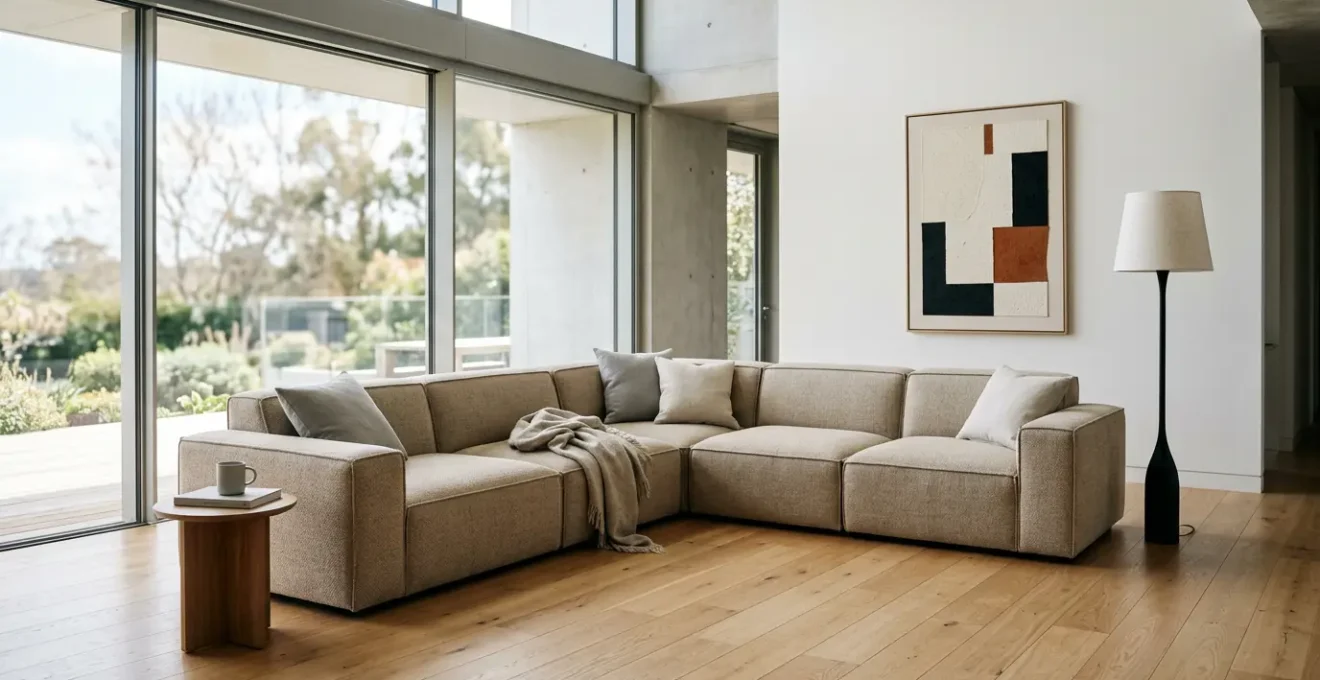
A modular sofa isn’t just flexible furniture; it’s a long-term financial asset that significantly lowers your 10-year cost of ownership compared to traditional couches.
- Repairing or replacing single, damaged modules is orders of magnitude cheaper than buying a new, monolithic sofa.
- High-quality hardware and materials extend the useful life well beyond the 10-year mark, actively fighting asset depreciation.
Recommendation: Evaluate modular sofas based on their Total Cost of Ownership (TCO)—initial price, material durability, hardware quality, and brand stability—not just the sticker price.
For most homeowners, buying a sofa is a significant but straightforward expense. You choose a style, pay the price, and hope it lasts. But what if this approach is fundamentally flawed? We’ve been conditioned to see furniture as a disposable good, a cost to be minimized at the point of purchase. This thinking overlooks the hidden expenses of repairs, replacements, and the sheer waste of discarding a large piece of furniture because one section is stained or a spring has failed. We accept the cycle of buying, breaking, and replacing without question.
The true cost of furniture isn’t the number on the price tag; it’s the total amount you spend over its entire lifespan. This is where the concept of Total Cost of Ownership (TCO) completely changes the game. Instead of viewing a sofa as a simple purchase, we must begin to see it as a long-term asset. The critical question shifts from “How much does it cost now?” to “What is the most cost-effective way to own comfortable, functional seating for the next decade?”
This article reframes the modular sofa not as a trendy, flexible seating option, but as a strategic financial decision. We will move beyond the surface-level benefits of adaptability and demonstrate, through the lens of TCO, how a well-chosen modular system systematically reduces costs over a 10-year period. It’s about understanding how individual component replacement, material science, and structural integrity create an asset that retains its value and function far longer than its traditional counterparts.
By exploring the economics of modularity, you will learn how to make an investment in your living space that pays dividends in durability, adaptability, and real, quantifiable savings for years to come.
Summary: The Investment Value of Adaptable Furniture Systems
- Why Replacing One Module Is Cheaper Than Buying a New Couch?
- How to Reconfigure Your Sectional for a Movie Night vs a Cocktail Party?
- Performance Fabric or Top-Grain Leather: Which Lasts Longer on Modular Pieces?
- The Hardware Oversight That Makes Cheap Modular Furniture Wobble
- When to Buy Add-Ons: The Risk of Discontinued Collections
- How to Zone a 400 sq ft Studio to Create a Separate Bedroom Feel?
- How to Soundproof Your Apartment Against City Noise Without Renovating?
- How to Zone a 400 sq ft Studio to Create a Separate Bedroom Feel?
Why Replacing One Module Is Cheaper Than Buying a New Couch?
The economic logic of modular sofas begins with a simple, powerful premise: you only need to fix what is broken. With a traditional sofa, a single catastrophic event—a deep wine stain, a pet-related disaster, or a broken frame—often condemns the entire piece to the landfill. This isn’t a minor issue; a comprehensive study revealed a staggering $23.5 billion spent by Americans on furniture replacement and repairs due to such damage. The cost of a new sofa can run into thousands, a significant and often unplanned expense.
A modular system dismantles this all-or-nothing financial risk. Instead of replacing an entire 3-seater, you replace a single seat module. The cost difference is dramatic. The price of one replacement module is a fraction of a new couch, turning a potential financial crisis into a manageable maintenance task. This transforms the sofa from a single, high-risk asset into a portfolio of smaller, low-risk components. This is the core of a favorable Total Cost of Ownership (TCO) analysis.
Case Study: The True Cost of Furniture
A TCO analysis reveals that while inexpensive furniture seems budget-friendly initially, it often becomes a “budgetary elephant in the room” due to high long-term costs from frequent repairs and early replacement. A true 10-year cost calculation must include the initial purchase, maintenance needs, and mid-life modification costs (like replacing a module). This analysis consistently shows that durable, repairable furniture like a quality modular sofa has a lower total monetary outlay over a decade, despite a potentially higher upfront cost.
By allowing for targeted repairs and replacements, a modular design fundamentally alters the depreciation curve of your investment. Instead of a steep decline to zero value after an accident, the sofa’s value is preserved by renewing only the affected part. This capability is the first and most direct way a modular sofa saves you significant money over its lifespan.
How to Reconfigure Your Sectional for a Movie Night vs a Cocktail Party?
The financial benefit of a modular sofa extends beyond repairability into its core function: adaptability. A traditional sofa has one form and one purpose. A modular sofa is a dynamic tool that can be reconfigured to meet the changing demands of your life, eliminating the need to own multiple, specialized pieces of furniture. This multi-functionality represents a significant, if indirect, cost saving. You are buying one system that does the job of three.
Consider two common scenarios: a cozy movie night and a lively cocktail party. For a movie night, you want an immersive, comfortable space. You can arrange the modules into a deep, U-shaped pit or an elongated chaise lounge, perfect for sprawling out. Everyone gets a front-row seat without needing extra beanbags or floor pillows. The sofa itself becomes the destination.
For a cocktail party, the goal is the opposite: to encourage flow and conversation among many guests. A large, monolithic couch acts as a barrier. A modular sofa, however, can be deconstructed into several smaller seating clusters. You can create two or three separate conversation zones, facilitating mingling and making the room feel larger and more dynamic. This adaptability is key; industry guides on event planning emphasize maintaining at least 30-36 inches of walkway space, a feat easily achieved by separating modules.
This chameleon-like ability means your living room is always optimized for its purpose. You don’t need to buy a separate daybed for lounging or additional accent chairs for parties. The sofa adapts to you, saving you money and space while maximizing the utility of your most important living area.
Performance Fabric or Top-Grain Leather: Which Lasts Longer on Modular Pieces?
When calculating the 10-year TCO of a modular sofa, material choice is paramount. The debate often centers on performance fabric versus top-grain leather, but for a modular system, the criteria are unique. It’s not just about which material is tougher, but which one best supports the paradigm of long-term use, repair, and potential expansion. While both are durable, they have profoundly different implications for the modular lifecycle.
Performance fabrics have made incredible technological strides. Designed for high-traffic commercial environments, quality versions boast abrasion ratings of over 100,000 double rubs, the standard for heavy-duty upholstery according to Association for Contract Textiles guidelines. They are engineered for stain resistance and high colorfastness, meaning a module placed near a window won’t fade at a different rate from the others. Crucially, their color is derived from stable dye lots. This means if you need to replace or add a module five years from now, the new piece will be a near-perfect color match to the original set, preserving the sofa’s aesthetic integrity.
Top-grain leather, conversely, is prized for its natural durability and the unique patina it develops over time. It can last for 20 years or more with proper conditioning. However, this aging process is its Achilles’ heel in a modular context. The color and texture of leather change with use, exposure to light, and body oils. A new module added years later will never match the beautifully aged patina of the original pieces. It will stick out like a sore thumb, compromising the cohesive look of the sofa and devaluing the entire set.
The following table breaks down these critical differences for a modular application:
| Characteristic | Performance Fabric | Top-Grain Leather |
|---|---|---|
| Abrasion Rating | 100,000+ double rubs (heavy-duty) | Varies; no standard rating |
| Replacement Module Matching | Stable color dye lots; seamless future matching | Patina mismatch; new modules never match aged leather |
| Repairability | Snags difficult to repair; full cover replacement possible | Patchable and conditionable; but color inconsistency remains |
| Colorfastness to Light | Grade 4+ rating prevents fading near windows | Natural patina development; color changes inevitable |
| Pilling Resistance | Grade 4 or higher for quality fabrics | N/A (smooth surface) |
| Lifespan for Modular Use | 10-20 years with proper care | 20+ years but module additions problematic |
| Maintenance | Machine-washable covers; stain-resistant treatments | Requires conditioning; vulnerable to scratches |
For a true long-term modular investment, performance fabric often provides a lower TCO by ensuring future compatibility and easier maintenance, even if leather has a longer raw lifespan.
The Hardware Oversight That Makes Cheap Modular Furniture Wobble
A modular sofa is only as strong as its weakest link, and that link is almost always the connection hardware. While fabric and cushions get the most attention, the unseen metal brackets and clips that hold the modules together are the single greatest determinant of the sofa’s structural lifespan and day-to-day stability. Inexpensive modular furniture cuts corners here, leading to the dreaded “wobble” and module drift that plagues low-quality pieces.
This isn’t just an annoyance; it’s a critical failure point that undermines the entire value proposition. If modules constantly slide apart, the sofa feels unstable and cheap, and the gaps can pose a risk of tripping or injury. As furniture experts point out, this instability is a clear red flag. The Soulfa Furniture Experts note in their buying guide:
If modular pieces slide apart easily, it is often a sign of weak connection hardware. High-quality modular sofas use secure connectors that lock the pieces together from underneath, keeping the layout stable during everyday use.
– Soulfa Furniture Experts, Best Modular Couch Buying Guide
High-quality systems use robust, heavy-duty steel connectors, such as interlocking “gator” clips or U-shaped brackets, that are bolted securely into the sofa’s hardwood frame. These mechanisms create a tight, immovable connection that can withstand the stress of daily use, including kids jumping or adults plopping down. They are designed for repeated use, allowing you to reconfigure the sofa many times without wearing out.
Conversely, cheap modular pieces often use flimsy, stamped-metal clips, plastic components, or even just rely on friction to hold pieces together. This hardware bends, breaks, or loosens over time, leading to the sections drifting apart. When assessing a modular sofa as a 10-year investment, inspecting the hardware integrity is non-negotiable. It’s the difference between a cohesive, solid piece of furniture and a wobbly collection of cushions that will frustrate you for years to come.
When to Buy Add-Ons: The Risk of Discontinued Collections
One of the most appealing promises of a modular sofa is the ability to expand it over time. You might start with a 3-seater and add a chaise lounge when you move to a bigger home, or an ottoman when you start a family. This promise, however, comes with a significant risk: the dreaded discontinued collection. The brand you buy from today might not exist in three years, or they may simply retire your specific model, leaving you with a beautiful but un-expandable sofa.
This risk is real. The modular furniture market is booming—market research indicates the global market was valued at $81.3 billion in 2023 and is projected to grow. This rapid growth attracts many new, often venture-backed startups. While innovative, these newer brands carry a higher risk of business failure or rapid product turnover compared to established furniture makers. If a brand goes under, your ability to source matching modules evaporates overnight.
Mitigating this risk is a key part of a long-term TCO strategy. It requires a proactive approach to brand selection and purchasing. Instead of simply buying what you need today, you must think like an investor assessing the long-term viability of your chosen ecosystem. The goal is to ensure your sofa remains a flexible asset, not a stylistic dead end.
Action Plan: Navigating Discontinuation Risk
- Brand Viability Assessment: Before buying, investigate the brand’s history. Look for companies with a long track record (10+ years), a physical retail presence, and robust warranties (lifetime or 20-year frame warranties are a good sign).
- Strategic Redundancy Purchase: For smaller or trend-focused brands, consider the “module insurance” strategy: buy one extra common piece, like a standard seat or ottoman, with your initial order. This is your hedge against future discontinuation.
- Set Up Second-Hand Alerts: Immediately after purchase, create saved searches on platforms like Facebook Marketplace, Kaiyo, or AptDeco for your specific sofa model and collection name. This gives you a head start on finding pre-owned pieces if needed.
- Identify a Local Upholsterer: Find a skilled upholsterer in your area before you need one. They can be invaluable for custom-making a compatible piece or re-covering a non-matching module if your collection is discontinued.
- Embrace Deliberate Mismatch: Plan a design strategy where a non-matching module could work. A complementary color or texture can be integrated as an intentional “accent piece” rather than a failed attempt at perfect matching.
By actively managing the risk of discontinuation, you protect the future adaptability—and therefore the long-term value—of your modular sofa.
How to Zone a 400 sq ft Studio to Create a Separate Bedroom Feel?
In compact urban living spaces like a 400 sq ft studio, creating a sense of separation between living and sleeping areas is a major challenge. Traditional solutions like bookshelves or folding screens can feel bulky, block precious natural light, and offer little functional value beyond division. This is where a modular sofa transitions from mere furniture into a powerful architectural tool, a concept particularly relevant as demand for space-maximizing furniture grows.
The key is to use the sofa itself as a “soft wall.” Unlike a solid divider, a low-profile modular sofa can create a physical boundary without creating a visual one. By strategically placing a 2- or 3-seater module with its back to the bed area, you create a clear demarcation for the “living room.” You can even use a configuration where one side of the sofa has no backrest, creating a low bench-like divider that feels open while still defining the space.
Case Study: The Modular Sofa as a Room Divider
In studios as small as a few hundred square feet, modular sofas excel. Their individual sections can navigate tight doorways and stairwells, a common hurdle in older apartment buildings. A strategic layout can use an L-shaped configuration to build a “corner” in the open-plan room, effectively creating a dedicated nook for the bed. This enhances the psychological feeling of having separate zones. Using a low-profile 2-seater as a soft wall divides the living and sleeping areas without impeding the flow of light from windows, making the entire studio feel larger and more organized.
This approach has a direct impact on your 10-year TCO. By serving a dual role as both seating and a room divider, the sofa eliminates the need to purchase a separate, single-use item like a large bookshelf or screen. Furthermore, when you move to a larger home, the sofa can be reconfigured back into a traditional sectional, whereas the now-useless room divider would likely be sold at a loss or discarded. This multi-functional utility is a cornerstone of long-term value.
How to Soundproof Your Apartment Against City Noise Without Renovating?
While not its primary function, a large, dense, well-constructed piece of furniture can play a surprising role in passive sound management in a noisy urban apartment. Sound travels in waves, and one of the basic principles of acoustics is that mass absorbs sound. Thick, heavy materials disrupt and dampen sound waves, reducing the amount of noise that passes through them. While you can’t completely soundproof a room without renovation, you can strategically use furniture to mitigate noise.
A substantial, high-quality modular sofa can act as a significant sound-absorbing barrier. Placing a large sectional along a shared wall or a wall facing a noisy street can help deaden ambient noise, from traffic hum to neighbors’ televisions. The key here is density and quality of construction. A cheaply made, lightweight sofa with low-density foam will have a negligible effect. A well-built modular sofa, constructed with a solid hardwood frame and high-density foam cushions, possesses the necessary mass to make a noticeable difference.
This ties directly back to the concept of investing in durability for long-term savings. The same qualities that make a sofa last for over a decade also make it a better acoustic damper. As the Povison Furniture Research Team notes in their guide:
When you start digging into durability, you’ll notice the same pattern show up repeatedly—across long-term durability tests and real-world usage reports, a well-built modular sofa can realistically handle 10+ years of daily use, while cheaper fast-furniture couches often start sagging or peeling in just 3–5 years.
– Povison Furniture Research Team, Modular Sofa Guide: Pros, Cons & How to Choose
By choosing a sofa built for a 10-20 year lifespan, you are also inadvertently choosing a piece with better sound-dampening properties. This dual benefit—longevity and a quieter living environment—further strengthens the TCO argument. You are getting an additional, tangible quality-of-life benefit from the same initial investment in a durable, long-lasting asset.
Key takeaways
- A modular sofa’s value is best measured by its Total Cost of Ownership (TCO) over 10 years, not its initial price.
- The ability to replace single modules drastically lowers long-term repair costs and fights asset depreciation.
- Investing in quality hardware and choosing materials suited for future matching (like performance fabrics) are critical for long-term value.
How to Zone a 400 sq ft Studio to Create a Separate Bedroom Feel?
We’ve established how a modular sofa can physically zone a small studio, but the financial wisdom of this strategy solidifies its place as a superior 10-year investment. Using your primary seating as an architectural element is an act of profound efficiency that directly impacts your Total Cost of Ownership. It’s not just about creating a “bedroom feel”; it’s about avoiding a cascade of additional costs associated with less flexible solutions.
Think of the alternatives. A contractor-built half-wall is expensive, permanent, and reduces the resale value of your apartment to those who prefer an open plan. A heavy, floor-to-ceiling bookshelf is a costly single-purpose item that is difficult to move and may not fit your next home. These are dead-end investments. The modular sofa, when used for zoning, incurs no extra cost. It performs this function while remaining your primary seating, and its value is not lost when you move. It simply reconfigures to suit a new, larger space, while the bookshelf ends up on the curb.
This strategic application enhances the sofa’s value by making it an active participant in your home’s architecture. It is a solution that adapts with you, from a 400 sq ft studio to a 2,000 sq ft house. Every time you reconfigure it to solve a new spatial problem—creating a reading nook, a guest sleeping area, or a formal living room—you are extracting more value from your initial investment and avoiding the purchase of another piece of furniture. This is the ultimate expression of a low TCO: one asset, multiple solutions, zero obsolescence.
Therefore, the next time you evaluate a sofa, shift your perspective. Don’t just look at the price tag. Analyze its potential TCO by assessing its repairability, hardware, material longevity, and brand stability. By choosing a quality modular system, you are not just buying a piece of furniture; you are investing in a flexible, long-lasting financial asset that will adapt to your life and save you money for the next decade and beyond.