
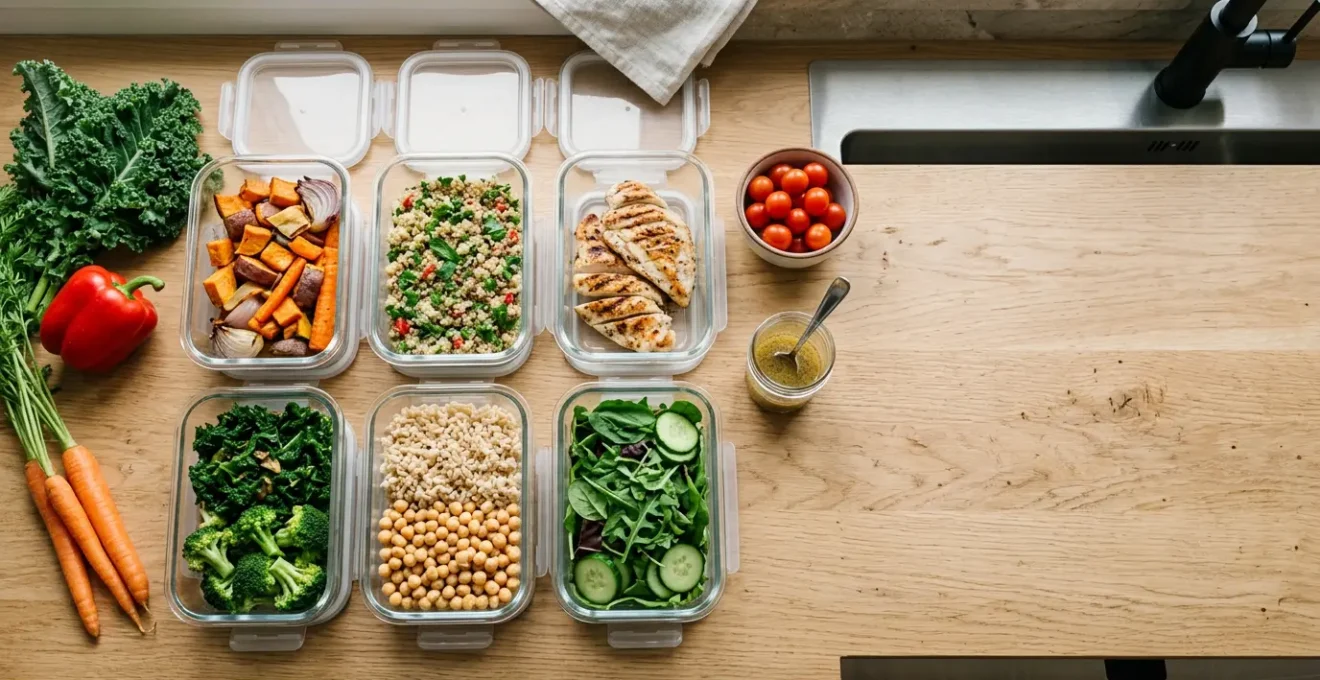
Meal prepping for a family isn’t about cooking more; it’s about implementing a high-efficiency system that saves you over 10 hours and hundreds of dollars weekly.
- Strategic “component prepping” creates incredible variety from single base ingredients, eliminating meal fatigue.
- Proper food safety protocols, like two-stage cooling, are non-negotiable for maximizing health and food longevity.
Recommendation: Shift your mindset from “batch cooking” to “kitchen workflow optimization” to unlock the 90-minute prep goal and reclaim your weeknights.
The evening rush for a family of four is a familiar scene: hungry children, tired parents, and the looming question of “what’s for dinner?” Many turn to takeout or processed foods, sacrificing both their budget and nutritional goals for a moment of peace. The common advice is to “meal prep,” a solution often envisioned as a full day of monotonous cooking, resulting in a fridge full of identical, uninspiring containers. This approach quickly leads to burnout and food waste.
The problem isn’t the concept of meal prep itself, but its execution. We’ve been taught to think in terms of “batch cooking” entire meals, a rigid method that fails to account for shifting appetites and the desire for variety. But what if the secret wasn’t about cooking more, but cooking smarter? What if you could apply the principles of a professional kitchen to your home, creating a high-efficiency system that delivers healthy, diverse meals in a fraction of the time?
This guide breaks that paradigm. We will move beyond the platitudes and introduce a strategic framework for meal prep. It’s a system focused on efficiency, food safety, and financial savvy. We will explore how to leverage single ingredients for multiple dishes, choose the safest materials for your family’s health, and implement critical food safety protocols. By transforming your prep day from a chore into a streamlined process, you can achieve the seemingly impossible: feeding your family of four all week with a prep session of under 90 minutes.
This article will guide you through the essential systems and strategies to master efficient family meal prep. Discover the financial benefits, core cooking techniques, safety protocols, and organizational hacks that will transform your kitchen and your schedule.
Summary: The 90-Minute Meal Prep System for Families
- Why Meal Prepping Saves You $400/Month on Food Costs?
- How to Cook 3 Different Meals from One Base Ingredient?
- Glass or BPA-Free Plastic: Which Container Is Safe for Reheating?
- The Cooling Mistake That Causes Bacteria Growth in Your Prepped Meals
- How to Organize Your Grocery List to Cut Shopping Time by 50%?
- How to Save a 6-Month Emergency Fund on a Median Salary?
- Standing Desk or Treadmill Desk: Which Actually Burns More Calories?
- Standing Desk or Treadmill Desk: Which Actually Burns More Calories?
Why Meal Prepping Saves You $400/Month on Food Costs?
The financial argument for meal prepping is often stated but rarely quantified with precision. The savings are not a myth; they are the direct result of eliminating two major budget drains: food waste and impulse food purchases. When you operate without a plan, you’re susceptible to last-minute takeout orders, expensive restaurant meals, and daily trips to the grocery store where un-budgeted items invariably find their way into your cart. This unstructured approach is incredibly costly.
The most significant, yet often invisible, cost is food waste. A meticulously planned prep session ensures every ingredient you buy has a designated purpose. You buy exactly what you need for the week, drastically reducing the chances of finding wilted vegetables or expired dairy in the back of your fridge. The financial impact is staggering; an analysis by the EPA estimated the annual cost of food waste is over $2,913 for a family of four. That’s more than $240 per month simply thrown away.
Systematic meal prep directly attacks this waste. Furthermore, it builds a powerful defense against the high cost of convenience. Having a ready-to-eat, healthy meal at home removes the temptation for expensive, last-minute decisions. The “$20 lunch” or “$60 family takeout” habit quickly adds up. By replacing just five convenience meals a week, a family can easily save over $100, which compounds to more than $400 a month. This isn’t just about saving money; it’s about reallocating your financial resources from wasteful habits to intentional goals.
How to Cook 3 Different Meals from One Base Ingredient?
The primary reason families abandon meal prep is “flavor fatigue”—the dread of eating the same chicken and broccoli for three consecutive days. The solution lies in a professional kitchen strategy called component prepping. Instead of cooking five identical finished meals, you prepare versatile, neutral bases that can be quickly transformed into distinct dishes throughout the week. This is the key to maintaining variety and making mealtime feel fresh and exciting, not repetitive.
The system is simple. Choose a versatile base protein (like shredded chicken, ground turkey, or chickpeas) and cook it with minimal seasoning—just salt, pepper, and a neutral oil. Then, prepare a few distinct flavor profiles: a container of taco seasoning with lime, a jar of Asian-inspired ginger-garlic-soy sauce, and a mix of Italian herbs with tomato paste. With these components ready, assembly takes minutes. On Tuesday, the ground turkey becomes tacos. On Wednesday, it’s transformed into a savory Asian noodle bowl. On Thursday, it’s the base for a rich bolognese sauce served over pasta.
This method not only saves time but also amplifies financial savings, as documented in a case study from Meal Prep Manual, which showed how systematic prep can slash monthly food expenditures dramatically. You leverage a single, often bulk-purchased ingredient across multiple meals, maximizing its value and minimizing waste. You’re no longer just a home cook; you’re a kitchen logistician, building a flexible system that adapts to your family’s cravings.
As the image above illustrates, the power of component prepping is visual. A single, neutral component is the hub, with various flavor “spokes” branching out to create a diverse weekly menu. This modular approach is the ultimate weapon against meal prep monotony and the cornerstone of an efficient, sustainable family food system.
Glass or BPA-Free Plastic: Which Container Is Safe for Reheating?
Your meal prep containers are not just storage; they are the vessels that hold and, crucially, reheat your family’s food. The choice between plastic and glass has significant implications for both health and the longevity of your meals. While high-quality, BPA-free plastic containers are lightweight and durable, a growing body of evidence points to glass as the superior choice, especially when heat is involved.
The primary concern with plastic, even when labeled “BPA-free,” is the potential for other chemical compounds to leach into food during microwaving or heating. These chemicals, known as endocrine disruptors, can interfere with the body’s hormonal systems. As one expert noted in a piece for Today.com, the risk is not something to be taken lightly. A Registered Dietitian stated:
plastic contains hormone disrupting molecules that we want to avoid, and can leach into our food with or without heat.
– Registered Dietitian, How to save money by meal prepping, according to nutritionists
Glass, on the other hand, is an inert material. It doesn’t leach chemicals, absorb odors, or stain, ensuring that the food you reheat tastes exactly as it did when you cooked it. While the initial investment in a set of quality borosilicate glass containers is higher, their durability and safety make them a more cost-effective and health-conscious choice in the long run. They are freezer, oven, microwave, and dishwasher safe, offering unparalleled versatility. Opting for glass is a one-time investment in your family’s health and peace of mind.
The Cooling Mistake That Causes Bacteria Growth in Your Prepped Meals
One of the most critical yet overlooked aspects of meal prep is food safety. The biggest mistake home cooks make is improper cooling. Placing a large, hot container of food directly into the refrigerator creates a perfect breeding ground for bacteria. The food in the center of the container cools too slowly, lingering for hours in the “temperature danger zone” (40°F to 140°F or 4°C to 60°C), where bacteria like *Staphylococcus aureus* and *Clostridium perfringens* can multiply to dangerous levels.
To ensure your prepped meals are safe to eat all week, you must adopt the two-stage cooling method used in professional kitchens. This process is designed to lower the food’s temperature through the danger zone as rapidly as possible. The first stage is to cool the food from 135°F down to 70°F within two hours. The second stage is to cool it from 70°F down to 41°F or lower in the next four hours.
The most effective way to achieve this at home is by dividing large batches of hot food into smaller, shallow containers to increase the surface area. Then, create an ice bath in your sink or a larger basin and place the shallow containers into the bath, stirring the food occasionally to release heat. Only once the food is cool to the touch (around 70°F) should it be covered and placed in the refrigerator. This protocol isn’t just a suggestion; it’s a non-negotiable step to protect your family’s health and preserve the quality of the food you’ve worked hard to prepare.
How to Organize Your Grocery List to Cut Shopping Time by 50%?
An efficient meal prep system begins long before you turn on the stove; it starts with an optimized grocery shopping trip. A disorganized list that has you backtracking through crowded aisles is a major time and energy drain. The most effective strategy to cut your shopping time in half is to organize your grocery list by store layout. Instead of a random list of items, you create a strategic map that guides you seamlessly from one end of the store to the other.
Before you go, take your weekly meal plan and break down every recipe into its component ingredients. Then, group those ingredients into categories that match the typical layout of a supermarket: Produce, Meat & Seafood, Dairy & Eggs, Dry Goods & Canned, Breads & Bakery, and Frozen Foods. Write your list in that order. You’ll complete all your produce shopping at once, then move methodically to the next section without ever having to double back for a forgotten lemon or can of tomatoes. This systematic approach eliminates wasted steps and decision fatigue.
This organized method also facilitates smart bulk buying, a key driver of savings. As you build your aisle-based list, you can more easily spot staple items like oats, rice, or oils that are cheaper to buy in larger quantities. A study cited by MagnifyMoney found that shoppers can see up to 25% savings when buying in bulk. An organized list allows you to incorporate these purchases without disrupting your shopping flow.
Action Plan: The Aisle-Based Grocery List
- Map Your Store: Mentally or physically sketch the layout of your primary grocery store (e.g., Produce first, then Bakery, then Meat, etc.).
- Categorize Your Meal Plan: Break down your weekly recipes into raw ingredients and assign each to a store category from your map.
- Build the List by Aisle: Write your final grocery list in the order you walk through the store. Group all produce items together, all dairy items together, and so on.
- Integrate Bulk & Staples: Create a separate, recurring sub-list for non-perishable staples (oats, rice, oils, canned goods) to check and replenish on a monthly basis.
- Pre-Shop Audit: Before leaving home, do a quick 2-minute check of your pantry and fridge against the list to prevent buying duplicates you don’t need.
How to Save a 6-Month Emergency Fund on a Median Salary?
This question may seem disconnected from meal prepping, but in reality, it addresses the ultimate outcome of a successful efficiency system. The hundreds of dollars saved each month through strategic meal prep are not just “extra cash.” When managed with intention, this new-found surplus becomes a powerful engine for building profound financial security, starting with an emergency fund.
For a family living on a median salary, the idea of saving a 6-month fund can feel impossible. However, the consistent savings from meal prep—potentially $400 or more per month—provide a dedicated, reliable stream of income to allocate directly to this goal. If you channel these savings into a high-yield savings account, you could build a substantial emergency fund of nearly $5,000 in just one year, without changing your income. This creates a critical buffer against unexpected job loss, medical bills, or home repairs, transforming financial anxiety into a sense of control.
But the power of these savings extends far beyond short-term security. Once your emergency fund is established, those same monthly savings can be redirected toward long-term wealth creation. As demonstrated in a compelling analysis by Meal Prep Manual, investing these funds can lead to astonishing results. The case study shows how investing just the annual savings from meal prep can compound over time, potentially growing to over a million dollars by retirement. Meal prep, therefore, is not just a kitchen hack; it is a foundational financial strategy that enables families to build stability and generational wealth.
Key Takeaways
- System Over Toil: Success in family meal prep lies in creating an efficient kitchen workflow focused on versatile components, not just cooking large, repetitive batches.
- Safety Is Paramount: Proper food safety, including using inert containers like glass and mastering the two-stage cooling method, is non-negotiable for your family’s health and preventing waste.
- Financial Engine: View meal prep savings not just as monthly budget relief, but as a powerful and consistent tool for building an emergency fund and long-term wealth.
Standing Desk or Treadmill Desk: Which Actually Burns More Calories?
At first glance, the debate between a standing desk and a treadmill desk seems far removed from the world of meal prep. However, it connects to the core philosophy of this guide: achieving significant results through small, consistent, and strategic efforts. For busy parents, especially those working from home, optimizing energy expenditure throughout the day is as crucial as optimizing time in the kitchen. Both meal prep and activity-based workstations are systems designed to improve well-being within a packed schedule.
The caloric difference is straightforward. A standing desk increases your energy expenditure over sitting, but the effect is modest. Research suggests you might burn an extra 20-50 calories per hour compared to being seated. The primary benefits are postural: improved core engagement, reduced back pain, and better circulation. It’s a low-impact, sustainable way to combat a sedentary lifestyle.
A treadmill desk, on the other hand, is a more active intervention. Walking slowly at 1-2 miles per hour can burn an additional 100-150 calories per hour. Over an eight-hour workday, this can add up to a significant deficit. The choice between them depends on your goal. If the aim is purely to maximize calorie burn, the treadmill desk is the clear winner. However, tasks requiring deep focus or fine motor skills (like design work or intense writing) can be more challenging while walking. The standing desk offers a middle ground, promoting activity without compromising focus.
The parallel to meal prep is clear. Just as consistent prep saves hundreds of dollars over time, consistent low-level activity burns thousands of extra calories. It’s about building a healthier lifestyle not through drastic, unsustainable overhauls, but through intelligent, integrated systems that work with your daily life.
Standing Desk or Treadmill Desk: Which Actually Burns More Calories?
While the previous section established the clear winner in terms of calorie burn, the true decision extends beyond simple mathematics. For a family-focused individual, the choice between a standing and treadmill desk should be framed within a holistic view of well-being. The ultimate goal isn’t just to burn calories, but to increase energy, improve focus, and model healthy habits for your children. The “best” desk is the one that best integrates into this larger vision of family wellness.
Consider the broader context. The goal of meal prep is to free up evening time and mental energy to be present with your family. Similarly, the goal of an active workstation should be to finish your workday feeling energized, not depleted. For some, the slow, steady pace of a treadmill desk is meditative and boosts creativity. For others, the quiet stability of a standing desk allows for deeper concentration, leading to a more productive and shorter workday—which in itself is a massive wellness benefit.
Moreover, these choices send powerful signals within the home. A parent who makes a conscious effort to stand and move during the day normalizes an active lifestyle for their children. It becomes a visible part of the family’s commitment to health, just like the colorful, prepped meals in the fridge. The question evolves from “Which burns more?” to “Which tool better supports my goal of being a healthy, focused, and present parent?” For some, that will be the high-output treadmill desk; for many others, the sustainable, focus-friendly standing desk will be the superior long-term choice for overall life-work harmony.
By implementing these high-efficiency systems in your kitchen, you are doing more than just planning meals. You are reclaiming your time, securing your finances, and investing in your family’s long-term health and well-being. To put these concepts into practice, the next logical step is to design your first component-based weekly meal plan.