
Contrary to popular belief, creative breakthroughs aren’t born from cramming more information in, but from strategically creating moments of ‘zero input’ to let the brain process it.
- The relentless consumption of content (podcasts, social media) actively blocks the brain’s natural idea-generating state, the Default Mode Network (DMN).
- Scheduling short, 20-minute sessions of deliberate, ‘input-free’ time is more effective for innovation than forced brainstorming.
Recommendation: Stop trying to ‘think harder’ and start engineering intentional boredom into your day. Treat it not as empty time, but as a critical cognitive process for defragmenting your mind and generating novel connections.
For creatives and strategists, the pressure to innovate is constant. The default solution is to consume more: more podcasts, more articles, more trend reports, more brainstorming meetings. We operate under the assumption that a greater volume of input will inevitably lead to a higher quality of output. We fill every spare moment—the commute, the lunch break, the walk around the block—with a stream of audio or text, terrified of the silence and what we perceive as unproductive emptiness. This constant state of ‘input-all-the-time’ has turned our minds into over-saturated sponges, unable to process the very information we work so hard to absorb.
The conventional wisdom about creative blocks points to burnout or a lack of inspiration. But what if the problem isn’t a lack of fuel, but a complete absence of an engine cycle to process it? What if our best ideas aren’t found in a frantic search for more data, but in the quiet, uncomfortable space we try so desperately to avoid? This is the paradox of creativity in the modern world: the relentless pursuit of stimulation is the very thing that stifles it. The key is not to add, but to subtract. This guide moves beyond the platitude of “just be bored” and provides a strategic framework for what creativity researchers call ‘cognitive withdrawal’—the deliberate, scheduled practice of doing nothing to achieve everything.
This article will deconstruct the myth of constant productivity and provide a scientific and practical roadmap. We will explore the neurological magic that happens in a state of ‘zero input,’ differentiate between restorative mind-wandering and draining passive consumption, and offer concrete methods to reclaim your focus and unlock the ideas currently trapped beneath the noise. By the end, you will have a clear understanding of not only why your best ideas come in the shower, but how to replicate that environment on demand.
Summary: Why Scheduled Boredom Triggers More Ideas Than Brainstorming Sessions
- Why Your Best Ideas Come in the Shower (And How to Replicate It)?
- How to Schedule 20 Minutes of “Zero Input” into Your Workday?
- Active Wandering or Passive Consumption: Which Resets the Brain?
- The Podcast Error That Blocks Your Inner Monologue
- How to Set Up a “Low-Stimulation” Zone in Your Office?
- How to Use Generative AI Without Losing Your Creative Voice?
- How to Reclaim 2 Hours of Daily Focus in a Distracted World?
- How to Use Generative AI Without Losing Your Creative Voice?
Why Your Best Ideas Come in the Shower (And How to Replicate It)?
The “shower idea” is not a myth; it’s a predictable neurological event. When you engage in a low-effort, familiar task like showering, washing dishes, or a routine walk, your brain’s “executive control network”—the part responsible for focused attention—takes a backseat. This allows another, more mysterious system to light up: the Default Mode Network (DMN). The DMN is the brain’s screensaver, the state it ‘defaults’ to when it’s not focused on an external task. This is the realm of daydreaming, self-reflection, and memory consolidation.
Crucially, the DMN is where your brain makes novel connections between seemingly unrelated concepts. It sifts through your vast library of stored memories and recent inputs, forming new pathways without the censorship of your conscious, critical mind. Groundbreaking research published in Molecular Psychiatry demonstrates that the DMN is not just correlated with but causally linked to creative thinking. By allowing the mind to wander freely, you are not being lazy; you are running a powerful background process for insight generation.
Replicating this effect doesn’t require more showers. It requires intentionally creating ‘input-free’ states where your body is on autopilot and your mind is free to roam. The key is to engage in an activity that is just stimulating enough to prevent you from getting sleepy or actively trying to solve a problem, but not so engaging that it commands your full attention. This is the sweet spot where the DMN activates and begins its work, connecting the dots that your focused mind could never see. As psychologist John Eastwood explains:
When we’re bored, our brains are relaxed and our usual ‘filters’ are off. In that gap, there’s a real chance to discover something new.
– John Eastwood, Out of My Skull: The Psychology of Boredom
Understanding this mechanism transforms boredom from a passive annoyance into an active creative strategy. The goal is to consciously step away from the firehose of information and give your DMN the quiet space it needs to synthesize, connect, and surprise you.
How to Schedule 20 Minutes of “Zero Input” into Your Workday?
The idea of scheduling “nothing” into a packed workday feels counter-intuitive, even irresponsible. The first few minutes of this intentional stillness can feel intensely uncomfortable, a sensation researchers call ‘boredom withdrawal.’ Your brain, accustomed to constant stimulation, will protest. The key is to treat this like any other new skill: start small and build capacity over time. Don’t aim for 20 minutes of silent meditation on day one; you’ll likely fail and abandon the practice. Instead, build a “boredom ladder.”
The initial phase involves ‘active boredom’—low-stimulation physical tasks that occupy your body but free your mind. Over several weeks, you can gradually reduce the level of physical activity, moving towards a state of pure ‘cognitive withdrawal’ where your mind can wander without any external anchor. This structured progression makes the practice sustainable.
The transition from a hyper-stimulated state to a moment of enforced quiet is often the most challenging part of the process, a moment of psychological friction.
As the image suggests, the initial moments of stillness require a conscious effort to resist the urge to fidget or reach for a device. To legitimize this practice in a professional environment, reframe it on your calendar. Instead of blocking time for “Boredom,” label it as “Strategic Thinking Time” or “Mental Defragmentation.” This small change shifts the perception from inactivity to a vital, high-level cognitive task. Here’s a progressive plan to build your ‘zero input’ capacity:
- Week 1-2: Start with 5 minutes of ‘active boredom’ (a slow walk without a phone, washing dishes mindfully).
- Week 3-4: Increase to 10 minutes of low-stimulation activities (staring out a window, sitting in a quiet space).
- Week 5-6: Progress to 15 minutes of ‘passive boredom’ with minimal movement.
- Week 7+: Build up to 20 minutes of true ‘zero input’ time, allowing complete mind wandering.
This isn’t about adding another task to your to-do list. It’s about strategically carving out a space for your brain to do the deep, connective work that focused effort cannot achieve.
Active Wandering or Passive Consumption: Which Resets the Brain?
A common mistake is to confuse all forms of “downtime” as being equal. Scrolling through a social media feed might feel like a break, but neurologically, it’s the opposite of restorative. It’s a form of attentional hijacking that keeps your brain in a reactive, externally-driven state, effectively blocking the DMN. This distinction is critical: not all boredom is created equal.
Mind-wandering is a near-universal human experience. In fact, research by Harvard University’s Matthew Killingsworth and Daniel Gilbert reveals that people spend as much as 50% of their waking hours daydreaming. The problem is not that our minds wander, but that we increasingly fill the opportunities for *productive* wandering with *unproductive* consumption. True cognitive reset comes from ‘Active Wandering,’ where the body is on autopilot and the mind is free. Passive Consumption, driven by algorithms designed to hold your attention, creates a low-grade cognitive load that prevents any deep processing.
Understanding the difference in brain activity is key to choosing the right kind of break. The following table, based on findings from neuroscience, breaks down how different activities impact your cognitive state and creative potential.
| Activity Type | Primary Network Engaged | Cognitive State | Creativity Impact | Examples |
|---|---|---|---|---|
| Active Wandering | Default Mode Network (DMN) + Executive Control Network switching | Divergent, body on autopilot, mind free | High – enables novel connections and insight | Walking familiar path, doodling, washing dishes, shower |
| Passive Consumption | Salience Network (reactive loop) | Externally driven, attentional hijacking | Low – blocks internal processing | Scrolling social media, watching shorts, continuous feeds |
| Structured Consumption | Executive Control Network dominant | Focused attention, information intake | Medium – fuels preparation phase, not reset | Reading books, watching documentaries, focused learning |
To reset your brain, the choice is clear. You must consciously opt out of passive, algorithm-driven feeds and choose activities that allow for genuine, unstructured mind-wandering. This is the only path to activating the DMN and reaping its creative rewards.
The Podcast Error That Blocks Your Inner Monologue
Podcasts and audiobooks have become the default tools for “productive” downtime. We fill our commutes, workouts, and chores with a constant stream of expert interviews and insightful narratives. While this feels like efficient learning, it creates a significant cognitive error: it completely silences your inner monologue. Your brain’s auditory processing channels are fully occupied, leaving no bandwidth for the DMN to engage in its crucial work of synthesis and reflection.
As the StrongMocha Research Team notes in their analysis of audio’s effect on the brain, the key is balance, not just consumption.
Continuous audio input may overwhelm the brain, limiting critical thinking and reflection. Striking a balance between podcast consumption and silent reflection is vital for peak brain health.
– StrongMocha Research Team, A Comprehensive Guide to Podcasts’ Good Effects on Your Brain
Listening to a podcast is an act of structured consumption, engaging the executive control network to follow an external narrative. It’s a valuable way to gather raw material, but it is not a creative act in itself. The creative act happens *afterward*, in the silence, when your DMN has the chance to process and connect this new information with your existing knowledge. To fix this, you don’t need to stop listening; you need to change *how* you listen by building in a mandatory “digestive period.”
Case Study: The Podcast Sandwich Technique
Cognitive science research demonstrates that podcasts require high intrinsic cognitive load as listeners must hold and integrate ideas sequentially. However, the true value emerges when followed by a ‘digestive period.’ Studies show that memory is strengthened when listeners actively visualize content rather than passively receive it. The ‘Podcast Sandwich’ approach—priming before listening, consuming the content, then enforcing a 15-minute no-input walk afterward—transforms passive listening into active creative processing, allowing the Default Mode Network to consolidate and connect new information with existing knowledge.
The takeaway is not to abandon podcasts, but to treat them as the start of a process, not the end. The real work begins when the audio stops. Schedule a 10-15 minute silent walk or a period of quiet reflection immediately after finishing an episode. This is when the valuable inputs you just received are transformed into genuine insights.
How to Set Up a “Low-Stimulation” Zone in Your Office?
Your physical environment sends powerful cues to your brain. An office cluttered with notifications, open tabs, and background noise is an environment designed for distraction, not deep thought. Creating a dedicated “low-stimulation zone” is a physical manifestation of your commitment to cognitive withdrawal. This isn’t about expensive minimalist furniture; it’s about a ruthless and intentional reduction of sensory input.
The goal is to create a space where the path of least resistance leads to mind-wandering, not distraction. This means curating your immediate environment to be as ‘boring’ as possible. Start with your digital space: close all unnecessary tabs and turn off all notifications. Then, address your physical space. Remove any clutter that isn’t essential to the task at hand. The ideal low-stimulation zone is radically simple, featuring only analog tools or with digital devices intentionally neutralized.
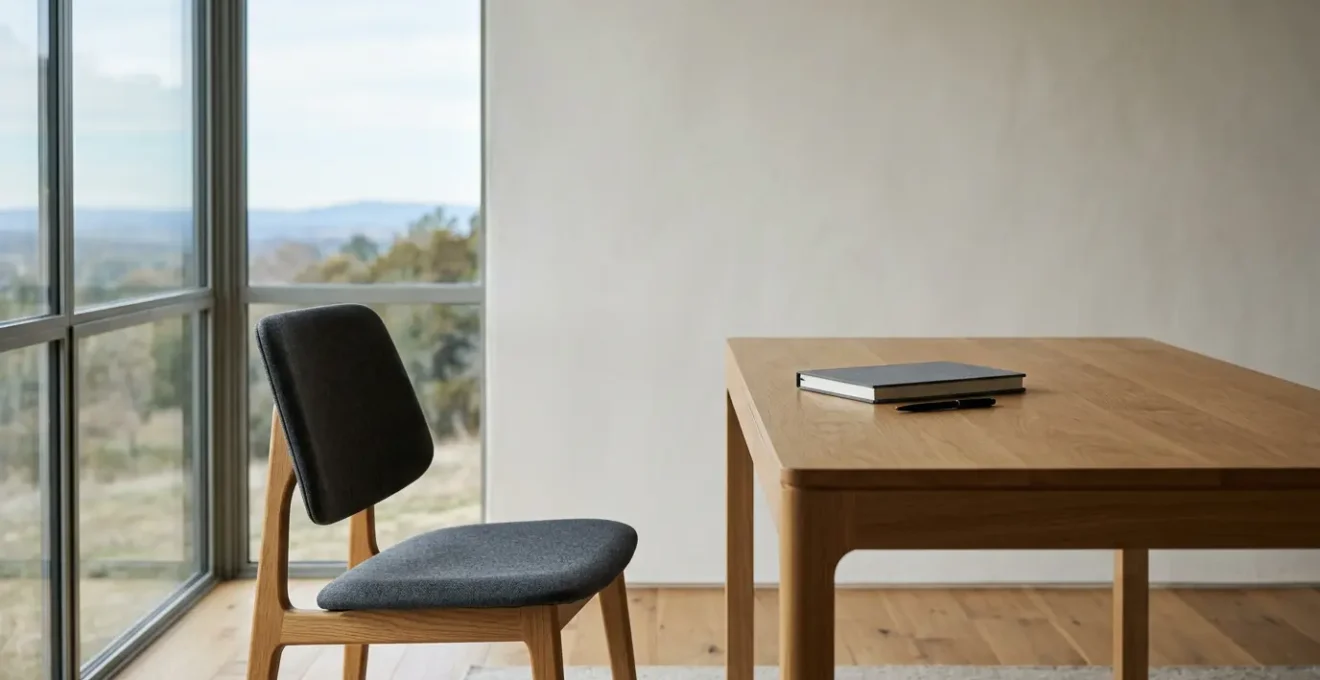
The visual simplicity of the space is a direct instruction to the brain: there is nothing here to react to, so you are free to turn inward.
As shown, a truly low-stimulation environment is defined by what it lacks. There are no blinking lights, no tempting notifications, and no visual clutter. To create your own, identify a specific chair, a corner of the room, or even just a time of day where you enforce these rules:
- Visual Simplicity: Face a blank wall or a neutral window view. Clear your desk of everything but a single notebook and pen.
- Auditory Silence: Use noise-cancelling headphones without playing any audio, or find a genuinely quiet space.
- Digital Blackout: Put your phone in another room. If using a computer, close all programs except a blank text document. Better yet, turn the monitor off entirely.
This space becomes a sanctuary for your DMN. By physically entering it, you are signaling to your brain that it is time to switch off the external focus and begin the internal work of creative synthesis.
How to Use Generative AI Without Losing Your Creative Voice?
Generative AI presents a modern paradox: it’s an unparalleled tool for divergent thinking, capable of producing a vast quantity of ideas, yet it poses a significant threat to the very creative voice it’s meant to serve. Relying on it too heavily for inspiration can lead to generic, soulless output that lacks a unique point of view. The solution is not to avoid AI, but to integrate it into a creative process that intentionally re-centers the human element through scheduled boredom.
The mistake is using AI as a replacement for thinking, rather than as a catalyst for it. The most effective approach is a relay race, where the human and the AI each play to their strengths. The human defines the problem and provides the final synthesis and taste, while the AI generates a wide, shallow pool of raw material. The critical, non-negotiable step in this process is the “mandatory boredom session”—a period of cognitive withdrawal *after* AI has generated its options but *before* you make any creative decisions.
This fallow period allows your DMN to process the AI’s output, connect it to your unique experiences and values, and surface the truly original insights that the machine could never produce. Without this incubation period, you are merely an editor of the AI’s voice, not the author of your own. The following framework provides a structured way to collaborate with AI while strengthening, not weakening, your creative identity.
Your Action Plan: The AI-Human Creative Relay Framework
- Stage 1 – Human Defines: Clearly articulate the creative problem or goal using your unique perspective and values before engaging AI.
- Stage 2 – AI Diverges: Use generative AI to create a wide, shallow pool of options and variations as raw creative material.
- Stage 3 – Mandatory Boredom Session: Disconnect completely for 20-30 minutes of scheduled boredom (walk, stare, daydream) to activate the DMN and allow unique insights to surface.
- Stage 4 – Human Synthesizes: Return to AI outputs with a fresh perspective, select, edit, combine, and inject your distinctive voice based on connections made during incubation.
This process transforms AI from a potential crutch into a powerful sparring partner. The more you use AI for divergence, the more crucial scheduled boredom becomes for developing the taste and perspective to guide it effectively.
How to Reclaim 2 Hours of Daily Focus in a Distracted World?
The challenge of creativity is inextricably linked to the crisis of attention. Our ability to focus is not just declining; it’s collapsing. A stark report highlights this trend, stating that the average screen-based attention has dropped to 43 seconds, with task switching occurring nearly every 51 seconds in a typical workday. This constant context-switching creates a state of perpetual “attentional residue,” where our cognitive resources are fragmented, leaving little capacity for the deep, uninterrupted thought required for both focused work and creative mind-wandering.
Dr. Gloria Mark, a leading researcher on digital attention, confirms this fragmentation is a primary source of cognitive overload. The path to reclaiming focus—and by extension, creative capacity—is not about willpower, but about systematically reducing the number of task switches and transforming our breaks from sources of further distraction into moments of genuine restoration. This means consciously replacing the 5-minute social media “break” with a 5-minute “zero-input” break, like staring out a window.
To reclaim your focus, you must first understand where it goes. Conduct an “Attentional State Audit” for one day. Instead of tracking tasks, track your mental state in 30-minute blocks using categories like:
- Deep Work: High-focus, complex thinking.
- Shallow Work: Administrative tasks, email.
- Passive Consumption: Scrolling, news feeds.
- Active Rest: Deliberate boredom, a walk without a phone.
This audit will reveal your peak focus windows and your biggest distraction triggers. Use this data to redesign your schedule. Cluster shallow tasks together. Schedule your most demanding cognitive work during your natural peak focus times, and most importantly, insert 10-minute “attention-clearing” boredom breaks between complex tasks to eliminate attentional residue. This systematic approach can help you reclaim hours of productive focus that were previously lost to fragmentation.
By transforming your breaks from distracting to restorative, you not only improve your ability to concentrate but also create dozens of small windows for your Default Mode Network to work its magic throughout the day.
Key Takeaways
- Creative insight is not a result of forced thinking but a predictable outcome of activating the brain’s Default Mode Network (DMN) through low-stimulation activities.
- Differentiate between ‘Active Wandering’ (walking, doodling), which fosters creativity, and ‘Passive Consumption’ (scrolling feeds), which actively blocks it.
- Integrate scheduled boredom into your routine by starting small (5-minute ‘zero input’ breaks) and reframing it as “Strategic Thinking Time” to legitimize the practice.
How to Use Generative AI Without Losing Your Creative Voice?
The principles of scheduled boredom and DMN activation are not just theoretical; they are the ultimate strategic defense for a creative’s most valuable asset: their unique voice. In an era dominated by generative AI, the ability to produce content is becoming commoditized. What cannot be commoditized is taste, perspective, and the ability to make surprising connections—the very skills cultivated during periods of ‘zero input’.
Viewing AI as an endpoint is a creative dead end. When you take the output of a large language model and publish it with minor edits, you are acting as a conduit, not a creator. The true power lies in using AI as the *beginning* of a process. It can provide the raw clay—a hundred variations of an idea, a dozen outlines for a strategy—but it cannot provide the sculptor’s vision. That vision is forged in the silence between inputs.
The ultimate application of this article’s philosophy is this: your value as a creative or strategist is no longer defined by the speed at which you can produce, but by the quality of your judgment. That judgment is a direct product of the time you spend in your own head, processing, synthesizing, and connecting ideas away from the noise of external input. Scheduled boredom is no longer a luxury; it is a core professional competency for anyone who wants to lead, not follow, in the age of AI. It is the only way to ensure the final product has a human soul.
Ultimately, the discipline of ‘cognitive withdrawal’ is what will separate the creative directors from the prompt engineers. To put these ideas into practice and develop a robust creative process that leverages both human insight and machine intelligence, the next logical step is to build a personalized framework for your own work.